Introduction
Open your smartphone, peek inside a medical monitor, or look under the hood of a modern car — you'll find the same thing: a circuit board packed with dozens, sometimes hundreds, of tiny components operating in precise coordination. Yet most people have no idea what those parts actually do. A resistor? A capacitor? An integrated circuit? They're just mysterious black rectangles and cylinders soldered to green boards.
Understanding these components isn't just for engineers. If you're building your first prototype, studying for a role in electronics manufacturing, or simply curious about what's inside your devices, knowing what each part does gives you a real foundation to work from.
This guide walks beginners through the essential components found on nearly every circuit board — resistors, capacitors, transistors, ICs, and more — explaining what each one does and why it matters in plain language.
Key Takeaways
- PCBs use copper traces on an insulating substrate to connect electronic components
- Passive components (resistors, capacitors, inductors) control and store energy without amplification
- Active components — transistors, diodes, and ICs — require power to switch signals, amplify current, or process logic
- Connectors, oscillators, LEDs, and fuses round out the board, handling power input, timing, indication, and protection
- Knowing your components makes designing, troubleshooting, and manufacturing PCBs significantly more reliable
What Is a Circuit Board (PCB)?
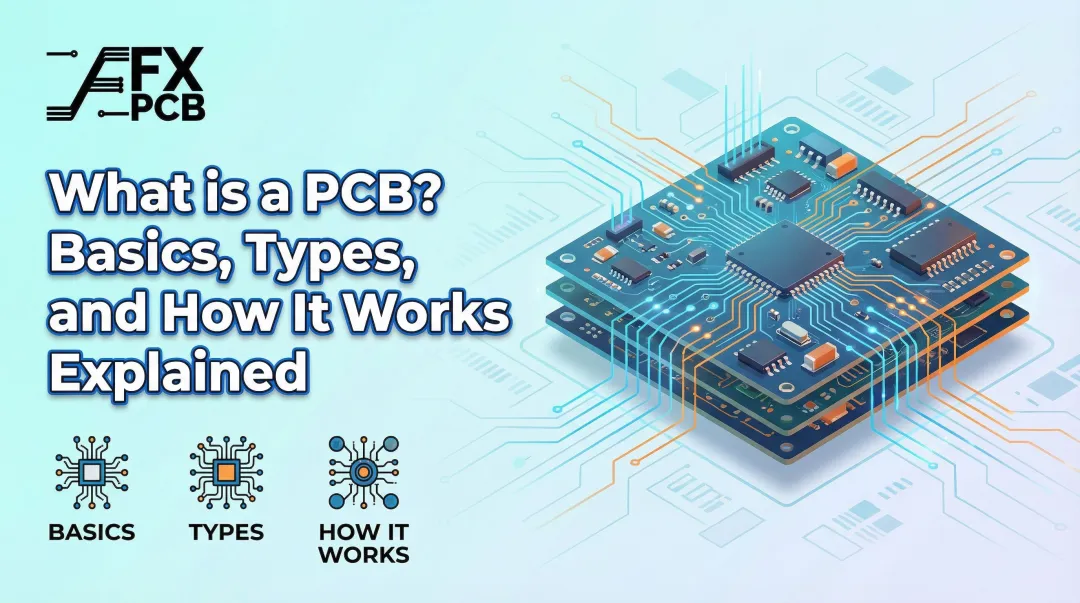
A printed circuit board (PCB) is an electronic assembly that uses copper conductors to create electrical connections between components while providing mechanical support. Picture the copper traces as the roads of a miniature city — they carry electrical signals between components the way streets carry traffic between buildings.
The Four Key Structural Layers
Every PCB is built from these fundamental layers:
- Substrate: The insulating base material, typically FR-4 (flame-retardant fiberglass-reinforced epoxy). FR-4 captured 44.7% of the substrate market in 2024 due to its optimal balance of strength, insulation, and cost
- Copper Layer: Etched conductive pathways (traces) that connect components and carry electrical signals
- Solder Mask: A protective coating covering the copper to prevent short circuits and solder bridges during assembly
- Silkscreen: Human-readable labels printed on top showing component outlines, reference designators, and company logos
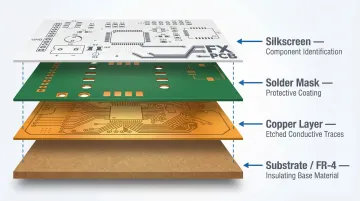
Bare Board vs. Assembled Board
A bare PCB is the fabricated structure with copper traces, solder mask, and silkscreen — but no electronic parts attached. Once components are soldered to the board, it becomes a Printed Circuit Board Assembly (PCBA).
How Components Are Mounted
Components attach to PCBs using two primary methods:
Surface Mount Technology (SMT): Components mount directly onto pads on the board's surface. This eliminates drilled holes, effectively doubling usable board area and allowing ultra-small component footprints. SMT accounted for over 72.7% of PCBA market revenue in 2025.
Through-Hole Technology (THT): Component leads insert into pre-drilled, plated holes and solder on the opposite side. This method delivers superior mechanical strength, making it the preferred choice for heavy connectors and high-stress power components.
Most modern boards use both methods strategically: SMT for dense digital circuits, through-hole for rugged physical interfaces.
Passive PCB Components: The Foundation of Every Circuit
Passive components don't generate or amplify electrical signals. Instead, they control, store, or dissipate energy. Every PCB uses passive components as its baseline building blocks.
Resistors
Resistors limit current flow and drop voltage in a circuit, protecting other components from receiving too much current. They're rated in ohms (Ω), defined as the resistance when 1 volt produces 1 ampere of current.
Identification: Marked with "R" on the board. Through-hole resistors use color bands defined by IEC 60062, while SMT resistors use numerical codes.
Common Types:
- Fixed resistors: Provide constant resistance for voltage division and current limiting
- Potentiometers: Adjustable resistors used in volume knobs and dimmer switches
- NTC thermistors: Resistance decreases as temperature rises, ideal for temperature sensors
- PTC thermistors: Resistance increases at a specific temperature, acting as resettable over-current protection
Capacitors
Capacitors store and release electrical energy in an electric field. They smooth voltage fluctuations in power supplies and block DC while passing AC signals. Rated in farads (F) and marked with "C" on the board.
| Type | Key Characteristics | Primary Use |
|---|---|---|
| Ceramic (MLCC) | Non-polarized, ultra-small, low ESR | High-frequency noise filtering, signal smoothing |
| Aluminum Electrolytic | High capacitance, polarized | Bulk power smoothing in power supplies |
| Tantalum | High capacitance in small size, polarized | Space-constrained applications requiring stability |
| Film | Highly stable, non-polarized | Audio circuits, high-voltage applications |
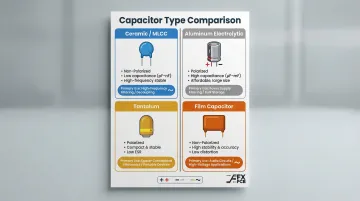
Critical Warning: Electrolytic capacitors are polarized. Applying reverse voltage causes rapid gas buildup until the safety vent ruptures or explodes.
Inductors
Inductors store energy as a magnetic field and resist sudden changes in current. They're rated in henrys (H) and marked with "L" on the board.
Unlike capacitors, which store energy electrostatically, inductors store it magnetically. This behavior is captured by V = L(di/dt): voltage equals inductance multiplied by the rate of current change.
Common Applications:
- Filtering noise and interference in power circuits
- DC-DC converters (buck/boost regulators)
- Radio frequency tuning and impedance matching
- Eliminating electromagnetic interference (EMI) using ferrite beads
Inductors come in several physical forms depending on the application:
- Wire-wound: Coils around magnetic cores, the most common general-purpose form
- Molded power inductors: Encapsulated in metal alloy for compact, high-current designs
- Air-core: No magnetic core material, used in high-frequency RF applications to avoid core losses
Active PCB Components: Controlling and Amplifying Signals
Active components require external power and can amplify, switch, or generate electrical signals. They give a PCB its intelligence and processing capability.
Diodes
A diode allows current to flow in only one direction (from anode to cathode), acting as a one-way gate. Marked with "D" on the board.
Diodes handle rectification, reverse-voltage protection, and signal processing. Common types include:
- Standard Rectifier: Converts alternating current to direct current in power supplies
- LED (Light-Emitting Diode): Converts electrical energy into light for status indicators and displays
- Zener Diode: Maintains constant reference voltage by operating in reverse breakdown mode
- Schottky Diode: Features 0.15V-0.45V forward voltage drops for high-efficiency power routing and fast switching
- Photodiode: Generates current when irradiated by light, used in optical switches and receivers
Transistors
Transistors act as both electronic switches (on/off control) and signal amplifiers. They're the fundamental building blocks of modern electronics.
The two dominant types work differently:
- BJTs (Bipolar Junction Transistors): Current-driven devices with three terminals (base, collector, emitter). A small base current controls a larger collector-to-emitter current. Available in NPN and PNP configurations.
- MOSFETs (Metal-Oxide-Semiconductor Field-Effect Transistors): Voltage-driven devices where an electric field at the gate controls current between source and drain. MOSFETs now drive most modern digital circuits and power management designs, favored for their high input impedance and switching efficiency.
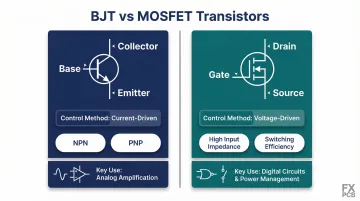
Scale of Integration: The NVIDIA H100 GPU contains 80 billion transistors on a single chip, demonstrating how transistor scaling enables modern computing.
Integrated Circuits (ICs)
An integrated circuit is a miniaturized assembly of transistors, resistors, capacitors, and other components fabricated onto a single chip of semiconductor material (usually silicon). ICs perform complex tasks in a fraction of the space discrete components would require. Marked with "U" on the board.
ICs fall into two broad categories:
- Analog ICs: Handle continuous signals such as sound waves or varying voltages. Operational amplifiers (op-amps) and audio decoders are typical examples.
- Digital ICs: Process binary signals (1s and 0s) for logic, arithmetic, and storage. This category includes microprocessors, logic gates, and memory chips.
Real-World Example: The Microchip ATmega328P microcontroller — the brain of the Arduino Uno — features an 8-bit processor, 32KB flash memory, 2KB RAM, and a 10-bit analog-to-digital converter. This single IC can run a smart thermostat that reads temperature sensors, displays information, and controls HVAC relays.
Other Important PCB Components to Know
Connectors and Crystal Oscillators
Connectors (marked "J" for fixed jacks, "P" for removable plugs per IPC-2612 standards) are physical interface points allowing PCBs to communicate with external devices, power sources, or other boards.
Common types include:
- Pin headers for board-to-board connections
- USB ports (Type-A, Type-C, Micro) for data and power
- FFC/FPC connectors for ribbon cables in laptops and cameras
- Edge connectors for daughterboards
Crystal Oscillators (marked "Y") generate precise, stable clock signals that keep all operations synchronized. They use the piezoelectric effect of quartz — mechanical pressure generates electric charge, and applied voltage causes vibration at a fixed frequency.
Crystals offer frequency stability between ±10 to ±100 ppm (parts per million), vastly outperforming internal MCU RC oscillators. Common frequencies: 32.768 kHz for real-time clocks, 8-48 MHz for main MCU clocking.
Fuses and Sensors
Fuses (marked "F") protect PCBs by breaking the circuit when current exceeds safe thresholds. Common fuse types include:
- Through-hole fuses — glass or ceramic tubes, easy to inspect and replace
- SMT fuses — miniaturized chips suited for compact board layouts
- Resettable fuses (PTCs) — increase resistance under overcurrent, then reset automatically once cooled
Sensors convert physical stimuli (temperature, light, motion, humidity) into electrical signals the PCB can process. The global IoT sensors market is projected to reach $106.01 billion by 2030, driven by smart home, automotive, and medical applications.
How PCB Components Work Together
No component functions in isolation. Each connects via copper traces to form a complete circuit where every part complements the others.
Take a smartphone's power circuit as an example: a voltage regulator IC receives battery power through a connector. Capacitors smooth voltage fluctuations. A resistor limits current to protect a transistor, which switches power to the display. An inductor in the DC-DC converter steps down voltage. Every part has a role — connected by copper traces into a working whole.
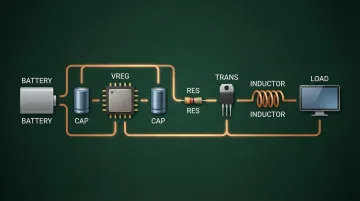
Mounting Methods Matter
Surface Mount Technology (SMT): Components mount directly on board pads. Automated pick-and-place machines can place tens of thousands of parts per hour before mass reflow soldering. This enables high board density and faster assembly at lower cost.
Through-Hole Technology (THT): Component leads pass through drilled holes, creating strong mechanical bonds. Slower to assemble but critical for heavy connectors, power components, and applications requiring extreme durability.
Most modern boards use both methods strategically — SMT for dense digital components, through-hole for rugged physical interfaces.
Knowing how these components interact also matters when you're ready to manufacture. A DFM (Design for Manufacturability) review — like the free analysis SFX PCB offers — checks that component selection, placement, and orientation will survive assembly without issues. Their engineers typically flag problems like insufficient spacing, annular ring errors, and clearance violations within 24 hours, before a single board goes into production.
Frequently Asked Questions
What are the main components of a circuit board?
Most circuit boards are built around these core components:
- Resistors — limit current flow
- Capacitors — store and release energy
- Inductors — store energy magnetically
- Diodes & transistors — control and switch current
- Integrated circuits — handle complex processing
- Connectors, oscillators, LEDs, and fuses — interface, timing, indication, and protection
What are the 5 basic components of an electrical circuit?
Every functional circuit requires five fundamentals: a power source (battery or supply), conductors (wires/traces), a load (like an LED or motor), a control component (like a transistor or switch), and a protective element (like a resistor or fuse).
What is the difference between active and passive PCB components?
Passive components (resistors, capacitors, inductors) store or dissipate energy without amplifying signals and don't require external power. Active components (transistors, diodes, ICs) require external power and can amplify or switch electrical signals.
How are components connected on a circuit board?
Components connect via copper traces etched onto the board's surface. They're physically attached using solder: either through surface mount (SMT) pads where components sit on the surface, or through-hole vias where component leads pass through drilled holes.
What does a resistor do on a circuit board?
A resistor limits the amount of current flowing through a circuit and can drop voltage across its terminals. This protects sensitive components from receiving excessive electrical current that could damage them.
What is the most important component on a PCB?
Integrated circuits — especially microcontrollers and processors — function as the brain of a PCB, handling decisions and data processing. That said, the answer shifts with the circuit's purpose: a power supply board, for instance, centers on its capacitors and regulators rather than any IC.