For industries like medical devices, automotive, and telecommunications, partner choice determines product quality, time-to-market, and total production cost. A manufacturer without ISO 13485 certification can't legally produce medical devices. One lacking IPC-A-610 Class 3 expertise will fail aerospace audits. And a partner with weak supply chain management will leave you stranded during component shortages.
This guide covers the complete evaluation framework: what defines an electronics manufacturing partner, the technical and operational criteria that separate reliable providers from risky ones, red flags that signal trouble, and how to make the final decision with confidence.
Key Takeaways
- An electronics manufacturing partner handles PCB fabrication, component sourcing, assembly, and testing—from bare boards to full turnkey production
- Vet partners on certifications (ISO 9001, ISO 13485, IPC-A-610 Class 2/3), supply chain depth, scalability, testing rigor, and communication transparency
- Look for partners offering free DFM analysis, 100% electrical testing, and layered inspection methods (AOI, X-ray, ICT, FCT)
- Prototype-to-production continuity matters—switching suppliers mid-growth introduces risk, delays, and quality gaps
- Red flags include vague quality documentation, outsourced core processes, unexplained low pricing, and missing traceability records
What Is an Electronics Manufacturing Partner?
An electronics manufacturing partner is a contract manufacturer that produces electronic hardware on behalf of an OEM or product company. The scope ranges from bare PCB fabrication through component sourcing, assembly, testing, and sometimes full box build integration. Unlike in-house manufacturing, partnering with an EMS provider transfers production responsibility to a specialist with dedicated equipment, certifications, and supply chain infrastructure.
Types of Electronics Manufacturing Partners
Three common partner types serve different stages of the production pipeline:
| Partner Type | What They Handle | Best For |
|---|---|---|
| Bare PCB Fabricator | Unpopulated board substrate: copper lamination, drilling, plating, solder mask, surface finish | Companies managing their own assembly or working with a separate PCBA partner |
| PCBA Assembler | SMT and through-hole population of boards you supply (consignment model) | Teams with established supply chains who need assembly expertise only |
| Turnkey EMS Provider | End-to-end: fabrication, component procurement, assembly, testing, and box build | OEMs outsourcing the full production process under one quality-controlled roof |
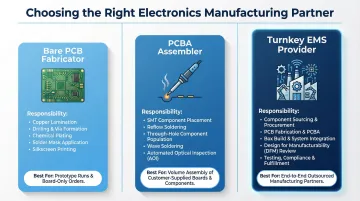
Most companies start with bare board fabrication or PCBA-only work, then shift to turnkey as volume increases. A partner that covers all three tiers from day one means you won't face re-qualification costs, non-recurring engineering (NRE) fees, or quality inconsistencies when you need to scale.
Key Factors to Consider When Choosing an Electronics Manufacturing Partner
Selecting the right partner goes beyond comparing price quotes. You're connecting technical specifications to measurable business outcomes: yield rate, time-to-market, compliance readiness, and total cost of ownership. Here's what to evaluate.
Technical Capabilities and Equipment
In-house equipment scope directly determines what your partner can manufacture, how fast, and at what quality level. Ask specifically about:
- SMT placement lines: High-precision machines for surface mount components
- Reflow ovens: Controlled temperature profiles for solder joint integrity
- Wave soldering: For through-hole component assembly
- Specialized capabilities: HDI, flex PCB, rigid-flex, metal-core boards, conformal coating
A partner operating modern SMT lines with 0.1mm BGA placement accuracy and laser drilling down to 4mil can handle complex, high-density designs. One relying on outdated equipment will struggle with fine-pitch components and multilayer boards.
DFM (Design for Manufacturability) analysis is a cost-reduction tool, not a courtesy. A partner offering free DFM review before production catches layout issues — insufficient trace spacing, annular ring breakout, solder bridging risks — that would otherwise trigger expensive rework.
According to industry benchmarks, catching a defect during design costs 1x; escapes to assembly cost 10x; field failures cost 100x or more. Partners who perform DFM upfront save 25–40% at the component level by preventing late-stage engineering change orders.
Quality Standards and Certifications
Certifications do more than satisfy auditors — they confirm a manufacturer has embedded structured quality control into every process step. Look for:
ISO 9001 establishes a baseline quality management system applicable across industries. It confirms documented processes, continuous improvement, and management accountability.
ISO 13485 is the medical device standard, requiring strict risk management, end-to-end traceability, and process validation from design through post-market surveillance. If you're manufacturing medical devices, this certification is non-negotiable.
IPC-A-610 Class 2 vs. Class 3 defines assembly quality standards. Class 2 applies to general industrial electronics (laptops, appliances) and permits limited cosmetic imperfections. Class 3 is the benchmark for high-reliability applications—aerospace, medical, military—where zero visual or functional defects are acceptable. Confirm which class your partner can certify to, not just claim. Specifying Class 3 for a Class 2 product unnecessarily drives up costs; specifying Class 2 for a critical device introduces unacceptable field failure risks.
RoHS and REACH ensure environmental compliance for global market access. RoHS restricts hazardous substances (lead, cadmium, mercury, phthalates) in electronics. REACH regulates chemical safety throughout the supply chain. Both are mandatory for selling into EU markets and increasingly required worldwide.
Supply Chain Management
A partner's supply chain depth — access to components, distributor relationships, and ability to manage obsolescence — directly affects lead times and your ability to stay on schedule during global shortages.
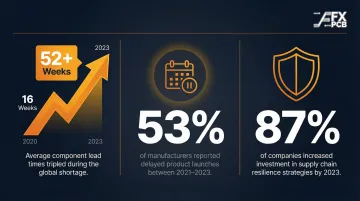
During the 2020–2023 component crisis, average lead times jumped from 16 weeks to over 52 weeks, and 53% of global electronics companies reported product launch delays or cancellations. That disruption forced a broad rethink: 87% of supply chain professionals are now investing in resilience over pure efficiency — prioritizing buffer stock and dual-sourcing over lean, just-in-time models.
Ask potential partners about:
- Preferred distributor relationships: Do they maintain agreements with authorized distributors like Digi-Key, Mouser, or Arrow?
- Local component stock access: Can they source from regional inventory to reduce lead times?
- Obsolescence management: How do they handle End-of-Life (EOL) components and pre-qualify alternatives during NPI?
- Multi-sourcing strategies: Do they maintain "supplier + 1" or dual-sourcing to reduce reliance on single vendors?
A mature EMS provider actively manages Bills of Materials (BOMs), flags obsolete parts early, and maintains buffer stock for critical components—preventing production stoppages when supply chains tighten.
Scalability From Prototype to Production
The ability to scale within a single vendor relationship is critical. Switching manufacturers between prototype and mass production introduces re-qualification risk, new NRE (Non-Recurring Engineering) costs, and potential quality variance.
A partner who handles both stages provides continuity: established quality standards, design familiarity, and a shared understanding of your product's tolerances.
NPI (New Product Introduction) support defines how a manufacturer transitions your design from concept to volume production. The process typically includes:
- Ideation and feasibility assessment
- Design optimization (DFM/DFA)
- Prototyping with production-intent materials
- Pilot runs (100-300 units) to validate yields and cycle times
- Volume manufacturing with continuous improvement
Ask potential partners:
- What's your minimum order quantity for prototypes?
- At what volume do you transition to high-volume production pricing?
- Do you assign dedicated program managers during NPI?
- Can you provide pilot run data (yield rates, cycle times) before committing to mass production?
Transferring from a prototype shop to a volume EMS incurs real hidden costs: NRE fees for new fixtures and stencils, 3-6 month re-qualification delays, and quality variance until the new line is calibrated. Choose a partner capable of scaling with you.
Testing Capabilities
Testing is the quality gate before boards ship. A partner offering comprehensive, multi-modal testing catches defects that single-method inspection misses. The four methods to look for:
- AOI (Automated Optical Inspection): High-resolution cameras catch surface defects — missing components, misalignment, tombstoning, solder bridges, polarity errors. Fast and effective, but can't see hidden joints.
- X-ray Inspection: Reveals BGA voids, solder bridges under components, and internal through-hole fill issues. Mandatory for area-array packages where joints are completely hidden.
- ICT (In-Circuit Testing): Bed-of-nails or flying probe testers verify electrical connections — shorts, opens, wrong component values, reversed parts — that visual inspection misses entirely.
- FCT (Functional Circuit Testing): Simulates real-world operating conditions to confirm the board performs as designed before it ships.
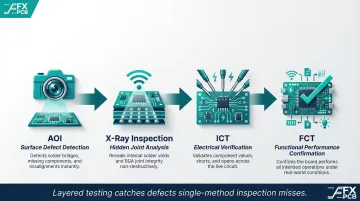
A reliable partner offers all four methods as standard practice. 100% electrical testing on bare boards (not sample testing) signals a higher baseline quality commitment. Skipping 100% bare board testing risks allowing latent defects into assembly, triggering the 10X cost multiplier for rework.
Communication, Transparency, and Partnership Culture
Technical capability alone isn't sufficient. A partner who communicates proactively about production status, flags engineering issues early, and treats design revisions as collaborative rather than transactional will reduce friction significantly over the project lifecycle.
Evaluate communication quality before committing:
- Request a sample audit report: Reputable EMS providers share certifications, process control data, and inspection records on request. Reluctance is a red flag.
- Clarify the ECO process: What's the documented procedure for engineering change orders mid-production? What's the typical turnaround time?
- Time their response during your initial inquiry: Do they answer technical questions in detail, or send generic sales copy? Response quality during evaluation predicts communication during production.
A partner who offers free DFM analysis, proactive design feedback, and transparent pricing treats the relationship as long-term — and that orientation shows in every production run.
Red Flags to Watch Out For
Vague or Unavailable Quality Documentation
Any reputable EMS provider should share certifications, process control data, and inspection records on request. If a potential partner hesitates to provide ISO certificates, IPC training records, or testing reports, that's a major risk indicator. Transparency in quality documentation reflects confidence in processes. Resistance to sharing records usually signals outdated certifications, inconsistent testing, or non-compliance with stated standards.
Over-Reliance on Subcontractors
If a partner outsources core processes like SMT assembly or testing to unqualified third parties, quality oversight becomes fragmented. Defects become harder to trace to their root causes, and you lose full traceability across the build. Before committing, ask three direct questions:
- Which processes are performed in-house vs. subcontracted?
- How do you qualify and audit subcontract suppliers?
- What visibility do I have into subcontractor quality records?
Unusually Low Pricing Without Clear Explanation
Pricing significantly below market rates should prompt scrutiny. The risk is hidden trade-offs that don't surface until products fail in the field:
- Component substitution — lower-grade or counterfeit parts to hit price targets
- Skip-lot testing — sampling instead of 100% board inspection
- Understaffed engineering — minimal DFM review or defect analysis support
- Unverified subcontractors — outsourced work with no audit trail
By the time these shortcuts become visible, you're already managing recalls, warranty claims, and reputation damage.
Ask how costs are controlled. Legitimate cost advantages come from operational efficiency — automated lines, bulk material purchasing, and direct manufacturer pricing — not from cutting corners on quality or testing.
Why SFX PCB Is a Trusted Electronics Manufacturing Partner
SFX PCB is a full-service PCB and PCBA manufacturer with over 15 years of experience, certified facilities in Shenzhen, China, and a US office in Plano, TX. The company serves global brands and fast-growing startups, providing a single partner from prototype through mass production.
Certifications Across Demanding Industries
SFX PCB holds ISO 9001, ISO 14001, ISO 13485, IPC-A-610 Class 2/3, RoHS, REACH, and UL certifications. ISO 13485 is particularly significant — it qualifies SFX PCB for medical device manufacturing, covering strict risk management and traceability requirements from raw material procurement through finished assembly.
Free DFM Analysis Before a Single Board Is Built
Engineers review Gerber files and BOMs to catch design issues — insufficient spacing, annular ring problems, trace width violations — before production starts. Catching these problems early costs 1x to fix. Left until downstream, the same issues run 10x to 100x more.
Testing Infrastructure Built Into Every Order
AOI, X-ray, and Functional Circuit Testing (FCT) are standard — not optional add-ons. Every bare board also undergoes 100% electrical testing before shipment. This layered testing approach aligns with IPC-A-610 Class 2/3 standards, so defects are caught before boards reach your team.
Core Differentiators:
- 15+ years of industry experience across consumer electronics, automotive, medical, aerospace, and telecommunications
- Seamless prototype-to-production scaling without requiring supplier changes
- Smart parts sourcing with access to over 600,000 local component stock items
- Direct manufacturer pricing with no middleman markup
- Fast-turnaround prototyping (boards assembled from 24 hours once parts are available)
- Proprietary waterproofing technologies including Parylene nano-vacuum coating (IPX-8 rated, -200°C to 200°C temperature range)
- Dedicated account managers and 12-hour response times for technical inquiries
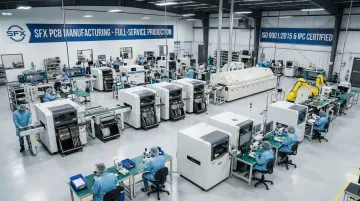
With fabrication, component sourcing, assembly, and testing under one roof, SFX PCB gives engineering and procurement teams a single point of accountability from first prototype to full-scale production.
Conclusion
Choosing a reliable electronics manufacturing partner is about finding alignment between your product's technical requirements, regulatory obligations, and long-term production roadmap—not simply selecting the lowest-cost option. The right partner brings three things together:
- Technical capability: advanced equipment, DFM expertise, and support for the PCB types your product demands
- Operational maturity: ISO certifications, IPC compliance, and a resilient supply chain
- Partnership culture: transparent communication, proactive engineering support, and the ability to scale from prototype through volume production
Revisit the partnership as your product evolves. A strong manufacturer keeps pace with you: adjusting to new regulatory requirements, scaling capacity as volumes increase, and managing component obsolescence before it disrupts your production schedule.
The partner you choose isn't just a vendor—it's the foundation your product is built on. Make that choice with the same rigor you apply to your design.
Frequently Asked Questions
What certifications should an electronics manufacturing partner have?
Look for ISO 9001 for quality management, ISO 13485 for medical devices, IPC-A-610 Class 2 or 3 for assembly standards, and RoHS/REACH for environmental compliance. Required certifications vary by target industry—medical devices require ISO 13485, aerospace demands Class 3 assembly standards, and global markets require RoHS/REACH compliance.
What is the difference between a PCB manufacturer and a PCBA manufacturer?
A PCB manufacturer produces the bare board substrate (copper layers, vias, solder mask). A PCBA manufacturer assembles electronic components onto that board using SMT and through-hole processes. Full-service partners handle both under one roof alongside component sourcing, testing, and box build integration.
How important is DFM analysis when choosing an electronics manufacturer?
DFM (Design for Manufacturability) analysis is a pre-production review that catches layout or design issues before manufacturing begins, preventing costly rework. Industry data shows fixing defects during design costs 1x, but fixing them during assembly costs 10x, and field failures cost 100x or more.
What testing methods should a reliable electronics manufacturer offer?
A comprehensive testing strategy includes AOI for visual solder inspection, X-ray for hidden joints like BGAs, ICT for electrical verification, and FCT for functional performance testing. 100% electrical testing on bare boards should be a standard offering, not an optional upgrade, to catch latent defects before assembly.
Can a small business or startup work with a contract electronics manufacturer?
Yes, many EMS providers work with startups and SMEs, particularly those offering prototype services alongside production. Look for partners that support low minimum order quantities (as low as 5 pieces for prototypes) and can scale with you as volumes grow—eliminating the need to switch suppliers mid-growth.
How do I evaluate an electronics manufacturer's supply chain capabilities?
Ask about preferred distributor relationships, local component stock access, strategies for managing obsolete parts, and how they handled supply disruptions during recent shortages. Request examples of multi-sourcing strategies and buffer stocking practices. These questions reveal the depth of their procurement infrastructure and resilience during component shortages.