
Introduction
A few weeks' delay in product development can cost far more than schedule time — product launch delays decrease a firm's market value by an average of 5.25%, translating to hundreds of millions in lost value. Standard PCB lead times typically run 2–6 weeks, creating a known bottleneck that frustrates engineering teams at every stage of development.
Design iterations stall when boards take too long to arrive, pushing back testing, refinement, and launch schedules. Hardware startups face a median of 19 weeks per prototype iteration — prototyping periods that stretch 1.8 to 2.5 years before reaching mass production readiness.
This article explains what quick turn PCB assembly is, its defining features, the key benefits it delivers, and how to choose the right partner — giving you a framework to accelerate product development and compress months-long cycles into weeks.
TLDR:
- Quick turn PCB assembly delivers assembled boards in 24 hours to 7 days, versus the standard 2–6 week wait
- Key features: upfront DFM reviews, automated SMT lines, pre-stocked components, and AOI/X-ray/electrical testing
- Core benefits: faster launches, early defect detection, rapid iteration, and smooth prototype-to-production scaling
- Choose partners with ISO9001/ISO13485 certs, broad component inventory, clear turnaround guarantees, and free DFM analysis
What Is Quick Turn PCB Assembly?
Quick turn PCB assembly is the accelerated end-to-end process of fabricating bare boards and assembling components onto them within a compressed timeframe: typically 24 hours to 7 days depending on complexity, compared to standard lead times of 2–6 weeks.
Speed is achieved through process design, not quality trade-offs. Streamlined pre-production workflows, dedicated scheduling slots, pre-stocked components, and upfront design reviews eliminate delays while maintaining compliance with standards like IPC-A-610 Class 2/3.
Primary use cases include:
- Prototyping new designs to validate functionality quickly
- Urgent low-volume production runs for time-sensitive launches
- Pre-production validation batches to stress-test designs before mass manufacturing
- Any scenario where speed-to-testing is critical — medical device development, consumer electronics launches, IoT product iterations
For engineering teams working on compressed schedules, this model compresses the gap between design revision and testable hardware — a practical advantage when development windows are measured in weeks, not quarters.
Key Features of Quick Turn PCB Assembly
Upfront DFM (Design for Manufacturability) Review
Quick turn services perform a DFM check immediately upon receiving design files, catching issues like incorrect footprints, inadequate trace clearance, or non-standard drill sizes before production begins. This prevents costly mid-run stoppages that would kill a fast turnaround.
Why this matters: Industry data shows that 60–90% of all SMT assembly defects are solder paste related, while component misalignment accounts for only ~20%. A thorough DFM review focuses on pad design, solder mask expansion, and stencil aperture ratios — not just pick-and-place coordinates — to prevent the most common failure modes before they occur.
Manufacturers like SFX PCB offer free DFM analysis on every order, reviewing Gerber files and BOMs to identify potential issues such as insufficient spacing, annular ring problems, and layout errors before production resources are committed.
Automated SMT Assembly Lines
High-precision surface mount technology (SMT) equipment — pick-and-place machines and reflow ovens — enables fast, accurate component placement at scale. Automation removes manual bottlenecks and supports both prototype and production volumes.
Modern pick-and-place machines can handle component sizes from 01005 (0402 metric) to large BGAs with ball pitches as small as 0.1mm, achieving placement precision of ±0.035mm. This level of accuracy ensures that even high-density designs with tight component spacing can be assembled reliably and quickly.
SMT Stencils for Solder Paste Application
Laser-cut SMT stencils (typically stainless steel framed or frameless) apply solder paste precisely to each pad before component placement. Stencils are a critical feature of quick turn assembly because they ensure consistent, repeatable solder deposits.
Without a stencil, manual paste application introduces variability and defects that add rework time and undermine the fast-turn timeline.
Common stencil types and tradeoffs:
| Stencil Type | Manufacturing Process | Best Use-Case | Key Advantage |
|---|---|---|---|
| Framed Stainless Steel | Laser-cut from high-hardness alloys | Prototypes, mid-pitch SMT (>0.5mm), high-volume runs | Excellent consistency, resists mechanical wear, lower cost |
| Frameless / Snap-in | Foil designed for tensioning systems | Prototype circuit boards, reusable stencil frames | Reduces storage space, lower shipping costs |
| Electroformed Nickel | Electrodeposition on substrate | Ultrafine pitch (<0.4mm), miniature components (0201, micro-BGAs) | Ultra-smooth trapezoidal walls, superior low-friction paste release |
Strategic insight: Standard stainless steel stencils struggle with paste release on ultra-fine pitches (<0.3mm), whereas electroformed nickel stencils provide trapezoidal, ultra-smooth walls that eliminate most instances of bridging and insufficient solder. For high-density quick turn prototypes, specifying electroformed nickel stencils ensures first-pass yield despite higher upfront tooling costs.
Pre-Stocked Component Inventory
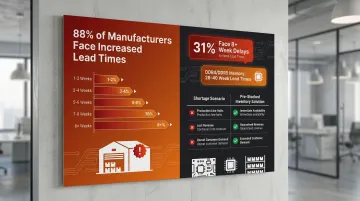
Quick turn assembly providers maintain large local component inventories or hold priority sourcing relationships to avoid delays from last-minute parts procurement. According to IPC data, 88% of electronics manufacturers experience increased lead times due to component shortages, with 31% facing delays of 8+ weeks.
Providers with deep local stock — such as SFX PCB's access to over 600,000 locally stocked parts — significantly reduce the most common source of quick turn delays. When critical components like DDR4 and DDR5 memory face lead times of 26–40+ weeks, pre-stocked inventory or alternative sourcing channels becomes essential.
Integrated Quality Control — AOI, X-Ray, and Electrical Testing
Fast sourcing and automated assembly only deliver value if the finished board is right. Quality control is built into the fast-turn workflow at every stage:
- Automated Optical Inspection (AOI) checks component placement and solder quality post-reflow, detecting 70–80% of assembly defects including missing components, misalignments, and solder bridges
- X-ray inspection detects hidden defects in BGAs and hidden solder joints that AOI cannot see, finding voids and marginal joints that might pass electrical testing but fail later mechanically
- 100% electrical testing on bare boards confirms circuit integrity, catching open circuits, short circuits, and incorrect component values before functional testing
Running all three in sequence — AOI, X-ray, then electrical test — catches the defect classes that each method alone would miss, keeping first-pass yield high without adding days to the schedule.
Top Benefits of Quick Turn PCB Assembly
Faster Time-to-Market
Compressing the prototyping phase from weeks to days allows engineering teams to move from concept validation to production qualification faster. First-to-market players enjoy a 6 percent market-share advantage over later entrants. In competitive product categories, that lead is difficult to recover once lost.
By receiving prototypes in days rather than weeks, teams can execute rapid cycle testing and launch products up to 40% faster than competitors relying on standard lead times.
Early Design Flaw Detection and Cost Savings
Identifying and correcting errors during the prototype stage is dramatically less expensive than discovering them during mass production. The 1-10-100 rule illustrates this escalation: a defect costing $1 to fix in design costs $10 in production and $100 post-release (due to recalls, warranty claims, and reputation damage).
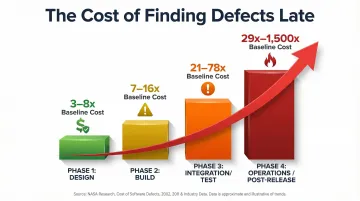
NASA research quantifies this further — if fixing a requirements error in the design phase costs 3–8x baseline, costs escalate sharply at each later stage:
- Design phase: 3–8x baseline
- Build phase: 7–16x baseline
- Integration/test: 21–78x baseline
- Operations/post-release: 29x to over 1,500x baseline
Free DFM analysis — available from manufacturers like SFX PCB — catches manufacturability issues before a single board is built, avoiding expensive rework or scrapped boards entirely.
Faster Design Iteration Cycles
Quick turn enables multiple back-to-back prototype builds within the time a standard process would deliver just one. This supports parallel testing of design variants, validation of engineering changes, and more confident progression to final design freeze.
Instead of the typical 19-week-per-prototype cycle that hardware startups face, quick turn assembly allows teams to iterate in days, compressing the typical 5-prototype cycle from years to months.
Reduced Production Risk Before Scale-Up
Using quick turn for pre-production validation batches allows teams to stress-test designs, verify component compatibility, and confirm manufacturability under real conditions — mitigating the risk of critical failures during mass production where the stakes are far higher.
Once that validation is complete, the path to scaling becomes far less risky — which is where continuity with your manufacturer becomes critical.
Seamless Scalability from Prototype to Production
Working with a quick turn provider that also handles full-volume production eliminates the re-qualification process when you're ready to scale. Design intent is preserved, quality standards carry forward, and there's no handoff delay between prototype and production runs.
SFX PCB supports this continuity directly — scaling from initial prototype quantities to high-volume production without requiring design resubmission, keeping quality consistent from first article through full ramp-up.
The Quick Turn PCB Assembly Process: Step by Step
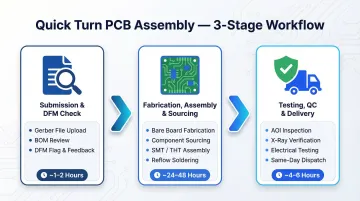
Submission and DFM Check
The customer submits Gerber files, BOM, centroid files, and assembly drawings. The manufacturer immediately performs a DFM review to flag manufacturability issues, then provides feedback for resolution before any production resources are committed.
This upfront review catches issues that would otherwise stall production mid-run, including:
- Incorrect component footprints or pad sizes
- Missing or mismatched solder paste layers
- BOM discrepancies and component conflicts
- Inadequate clearances between traces or pads
Fabrication, Assembly, and Component Sourcing
Bare board fabrication, component sourcing, SMT/THT assembly, and reflow soldering run in a coordinated sequence managed against a dedicated fast-turnaround schedule. Pre-positioned inventory and reserved machine time are what compress this stage from days into hours.
For mixed-technology boards (SMT + through-hole), surface mount and DIP assembly run within the same workflow — no separate production runs, no added lead time.
Testing, Quality Control, and Delivery
The post-assembly QC pipeline includes:
- AOI inspection for visual and placement defects
- X-ray for hidden joints in BGAs and QFNs
- Functional/electrical testing (FCT/ICT) to verify the board operates correctly
- Final visual inspection
Boards that pass are packaged and dispatched the same day or next day via DHL, FedEx, or UPS — reaching most North American and European destinations within 3–5 business days.
Design Tips to Maximize Quick Turn PCB Assembly Success
Simplify Board Design and Use Standard Components
Minimize unnecessary layer count, avoid exotic materials unless required, and specify standard footprint components with known availability. Complex, non-standard designs introduce sourcing and fabrication delays that undermine the entire fast-turn advantage.
Higher quality standards like IPC Class 3 or military specifications increase both cost and lead time. Match your design complexity to your actual requirements — if Class 2 standards meet your application's needs, over-specifying only slows you down.
Follow DFM Guidelines from the Start and Prepare Complete Documentation
Engage with the manufacturer's DFM guidelines early — covering trace width/clearance, pad sizes, drill aspect ratios, and panelization requirements — to prevent back-and-forth revisions.
Complete documentation package includes:
- Gerber files
- BOM with approved alternates
- Centroid/pick-and-place files
- Assembly drawings
- Explicit test requirements
Incomplete or unclear documentation causes delays while the manufacturer waits for clarifications.
Plan for Component Alternatives
Pre-identify secondary component options for critical parts before submission. Single-source components without approved alternatives are the most common cause of avoidable delays in quick turn schedules.
To eliminate this risk before it surfaces:
- Confirm availability for critical components before submitting files
- Pre-approve at least one alternative source per key part
- Note that all substitutions — including manufacturer-suggested alternatives for passives — require your sign-off before use
Experienced procurement teams can propose cost-effective alternatives quickly, but staying ahead of sourcing gaps is the fastest path to keeping your quick-turn schedule intact.
How to Choose the Right Quick Turn PCB Assembly Partner
Verify Certifications and Quality Standards
Meaningful certifications — ISO9001 for quality management, ISO13485 for medical applications, and IPC-A-610 Class 2/3 for assembly acceptability — are reliable indicators that a provider meets industry-recognized standards, not just self-reported claims.
Each certification addresses a distinct layer of quality assurance:
- ISO9001 ensures consistent processes, traceability, and continuous improvement
- ISO13485 demonstrates rigorous risk management, strict process controls, and comprehensive traceability required for medical devices
- IPC-A-610 Class 2/3 defines visual and workmanship acceptance criteria for electronic assemblies
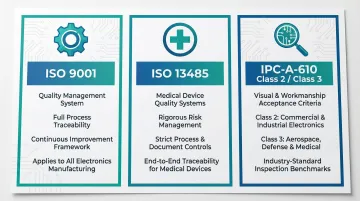
Class 2 (Dedicated Service Electronics) covers industrial controls, telecommunications, and commercial electronics. Class 3 (High-Reliability) is required for aerospace, defense, and medical life-support systems.
Applying Class 3 standards to a Class 2 product unnecessarily increases manufacturing costs and lead times without proportional reliability gains for standard operating environments.
Assess Component Sourcing Capability and Inventory Depth
Component availability is the most common source of quick turn delays — so the depth of a provider's local inventory and sourcing network matters as much as their assembly speed. SFX PCB, for example, maintains access to over 600,000 locally stocked parts, which directly shortens procurement lead times on most orders.
When evaluating a provider, ask directly:
- What is your local component inventory depth?
- How do you handle single-source components or shortages?
- What are typical procurement lead times for non-stocked parts?
- Do you proactively suggest approved alternates?
Evaluate Turnaround Transparency, Scalability, and Support
The right partner should be able to grow with your project — from a 24-hour prototype run to high-volume production — without requiring a supplier switch mid-development. Clear turnaround commitments and free DFM analysis on every order are baseline expectations, not premium add-ons.
Watch for these warning signs during evaluation:
- Vague turnaround promises without specific timeframes
- No DFM review process or upfront engineering support
- Prototype-only shops that can't scale to production
- Slow response times to inquiries (look for 12–24 hour response commitments)
Dedicated engineering support is particularly important once an order is in progress — design issues discovered mid-run need fast answers, not a ticket queue. SFX PCB offers 24-hour quotation turnaround and 12-hour customer support response times to keep projects moving without unnecessary holds.
Frequently Asked Questions
What is the fastest turnaround time for rapid-turn PCB assembly?
Leading quick turn PCB assembly providers can deliver assembled boards in as little as 24 hours once all components are confirmed available and design files are approved. More complex or multi-layer boards typically range from 3–7 days depending on layer count, component density, and testing requirements.
What is the difference between quick turn PCB assembly and standard PCB assembly?
The key differences lie in production scheduling priority, pre-stocked components, upfront DFM review, and streamlined workflows — not in quality standards. Both quick turn and standard assembly adhere to the same IPC-A-610 compliance requirements; quick turn simply eliminates waiting time through dedicated scheduling and optimized processes.
What is the 3W rule in PCB assembly?
The 3W rule is a PCB design guideline stating that the spacing between any two parallel traces should be at least three times the width of the trace. This reduces electromagnetic interference (EMI) and crosstalk by nearly 70%. Following it during design helps avoid DFM issues that can delay quick turn production, though it's a signal integrity heuristic rather than a strict IPC-2221C voltage-clearance mandate.
What are the common PCB testing methods?
The four primary methods are AOI (visual/placement defects), X-ray inspection (hidden solder joints in BGAs and QFNs), In-Circuit Testing or ICT (electrical connectivity), and Functional Circuit Testing or FCT (board performance under operating conditions). Quick turn providers integrate all four without extending lead times.
What are common stencil types used in PCB assembly and what happens if one is not used?
The three main types are framed stainless steel, frameless/prototype, and electroformed nickel for fine-pitch components. Skipping a stencil results in inconsistent solder paste volumes, bridging, and cold joints — significantly raising defect rates and undermining the reliability a quick turn build requires.
Is quick turn PCB assembly suitable for high-volume production?
Quick turn is optimized for prototyping and low-to-mid volume runs, but capable manufacturers scale to full production without switching suppliers. This means no requalification delays and consistent quality from first article through mass production.