The challenge is that most manufacturers look comparable on paper. Certifications, turnaround promises, and competitive pricing are table stakes in any quote. What separates a reliable manufacturing partner from a costly mistake is what sits beneath those surface claims: the quality systems, engineering depth, testing infrastructure, and supply chain controls that determine whether your product actually ships on time and performs in the field.
This guide covers what to evaluate, what to require, and what to walk away from when selecting a custom PCBA manufacturer.
Key Takeaways
- Custom PCBA manufacturing means fully assembled, tested, functional boards — not just bare PCB fabrication
- The right partner must match your technical complexity, compliance requirements, and volume trajectory — price alone is a poor selection criterion
- Evaluate manufacturers on capabilities, certifications (ISO 9001, ISO 13485, IPC-A-610), DFM support, testing depth, and supply chain control
- Red flags: no auditable certifications, no DFM review, no in-house testing beyond visual inspection
- A turnkey partner handling procurement, assembly, and testing under one roof cuts handoff errors, speeds delivery, and lowers per-unit cost
What Is Custom PCBA Manufacturing?
A PCB (Printed Circuit Board) is the bare substrate — copper traces, pads, and vias, but no components. A PCBA (Printed Circuit Board Assembly) is the finished, functional product: components placed, soldered, and verified against your design requirements. Only the PCBA goes into a product.
Custom PCBA manufacturing covers the full sequence: component procurement, SMT and/or through-hole placement, soldering, inspection, and electrical and functional testing. Specifying a manufacturer without understanding where their scope ends — bare board or fully assembled — is a common and expensive miscommunication.
SMT vs. Through-Hole vs. Mixed Assembly
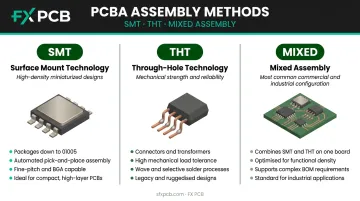
Most modern assemblies require more than one method:
- SMT (Surface Mount Technology) — components placed directly on the board surface; suited for high-density, miniaturized designs; supports packages down to 01005
- THT (Through-Hole Technology) — component leads inserted through drilled holes and soldered; preferred for connectors, transformers, and high-mechanical-load components
- Mixed assembly — combines both methods on the same board; the most common configuration in commercial and industrial electronics
Turnkey vs. Consigned Assembly
| Model | Who Handles Components | Best For |
|---|---|---|
| Turnkey | Manufacturer sources and procures everything | Fastest delivery, lowest coordination burden |
| Partial turnkey | Buyer supplies some components | When you have approved vendor lists or existing inventory |
| Consigned | Buyer supplies all components | Full control over sourcing, but adds risk and complexity |
For most commercial and industrial buyers, full turnkey is the practical default — it reduces BOM completion risk, shortens lead time, and keeps accountability with a single supplier. Understanding which model fits your sourcing situation is one of the first questions to settle when evaluating manufacturers.
What to Consider When Choosing the Best Custom PCBA Manufacturer
Manufacturer selection criteria shift based on application, volume, and regulatory environment. A medical device supplier must hold ISO 13485 and demonstrate full traceability. A consumer electronics supplier prioritizes throughput and cost. Matching those criteria to measurable outcomes — first-pass yield, compliance timelines, field return rates — makes this a strategic decision, not a price comparison.
Manufacturing Capabilities and Technical Expertise
A manufacturer's technical range sets a hard ceiling on what your design can become without compromise.
Key specifications to verify before committing:
- Layer count support — does it cover your current design and foreseeable revisions?
- Minimum trace/space tolerances — fine-pitch designs (BGAs, QFNs) require manufacturers who can reliably hold 3 mil or tighter
- Board materials — FR4 covers most applications, but Rogers, aluminum, high-Tg, and halogen-free materials require specific process controls
- Component packages — BGA, QFN, micro-BGA, and 01005 components demand precision placement equipment and X-ray inspection capability
These specifications directly affect first-pass yield rate and design iteration cycles — and determine whether you can scale complexity without switching suppliers mid-program.
Certifications, Quality Standards, and Compliance
Certifications are not marketing claims. They define the quality management systems, environmental controls, and workmanship standards the factory operates under. Require documentation — not just a logo on a website.
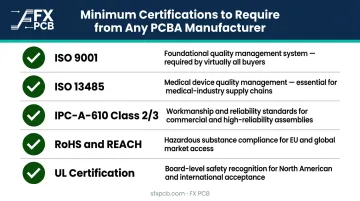
Minimum certifications to request:
- ISO 9001 — quality management system (all PCBA buyers)
- ISO 13485 — medical device QMS (required for medical applications)
- IPC-A-610 Class 2 or Class 3 — assembly workmanship standards; Class 3 applies to high-reliability products where field failure is not acceptable
- RoHS and REACH compliance — required for products entering EU markets and most global supply chains
- UL certification — relevant where board-level recognition is required
IPC-A-610 defines acceptance criteria for electronic assemblies and sets the workmanship standard your manufacturer should be held to. Class 3, used for high-performance and high-reliability electronics, imposes stricter defect tolerances than Class 2 — a distinction with direct consequences for field failure rates and warranty exposure.
DFM Support and Engineering Collaboration
DFM (Design for Manufacturability) analysis is a pre-production review where the manufacturer examines your Gerber files and BOM for issues that could cause assembly defects, yield loss, or costly rework. Common findings include:
- Component footprint mismatches
- Insufficient pad spacing for automated placement
- Annular ring violations
- Thermal management concerns
- BOM risks — discontinued parts, long-lead items, or unqualified substitutes
IPC's 2022 electronics assembly benchmark identified rising rework and scrap costs and yield variability as the top internal quality challenges facing assemblers — both are reducible through rigorous pre-production DFM review.
A manufacturer that quotes without reviewing your Gerber files is taking your design to assembly blind — a first-article failure waiting to happen. Ask specifically: Does DFM review happen before production begins, or only when something goes wrong? Is the report shared with you, or kept internal?
Testing and Inspection Protocols
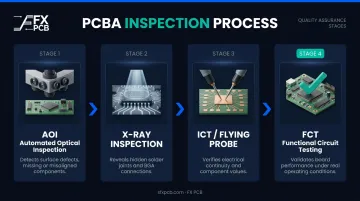
Testing is where quality claims get verified. A reliable PCBA manufacturer should operate a multi-layer inspection stack:
- AOI (Automated Optical Inspection) — detects surface-visible solder defects and placement errors after reflow
- X-ray inspection — required for BGAs and hidden solder joints that AOI cannot reach; IPC-J-STD-001 explicitly covers X-ray use for through-hole solder inspection
- ICT (In-Circuit Test) or Flying Probe — validates electrical continuity and component-level faults; flying probe is preferred for low-volume and prototype runs without dedicated fixtures
- FCT (Functional Circuit Testing) — simulates real operating conditions to confirm the assembled board performs as designed
Additionally, ask whether every bare board receives 100% electrical testing before assembly begins. Catching a PCB fabrication defect before components are placed is far cheaper than discovering it after assembly.
The metrics this drives are DPPM (defective parts per million) and field return rates. A 2019 study published in SMT007, spanning 15 major OEM/EMS companies and over 325,000 boards, found defect levels ranging from 650 to 10,000 PPM. That spread reflects inspection rigor more than any other single variable.
Turnaround Time and Scalability
Two questions matter here, and they're often asked separately when they should be evaluated together:
How fast can you deliver prototypes? Prototype turnaround from parts availability to shipment is a key KPI for product teams on compressed development schedules. That timeline is separate from component procurement lead time — verify both with your manufacturer.
Can you support this product through mass production? Switching suppliers mid-development carries real costs:
- Resets DFM learning accumulated during prototyping
- Introduces yield uncertainty in the new process
- Adds qualification time and NRE (non-recurring engineering) fees
- In regulated industries, may trigger formal change-control reviews
Selecting a manufacturer that can scale from 5-piece prototypes to tens of thousands of units eliminates re-qualification costs and the yield variability that comes with restarting a new process. Verify scalability with evidence: ask for their current mass production throughput and the specific process for transitioning a product from prototype to production run.
Supply Chain Management and Component Sourcing
Component sourcing is where PCBA programs get derailed — often without warning. Long-lead items, counterfeit parts, and BOM completion gaps cause delays that fast assembly cannot recover.
ERAI's 2024 annual report recorded 1,055 suspect counterfeit and nonconforming parts — a 25% increase from 2023 and the highest volume since 2015. For medical, automotive, and defense applications where component traceability is mandatory, this is not an abstract risk.
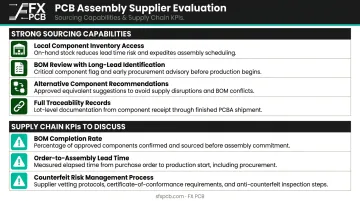
What a strong sourcing capability looks like:
- Access to broad local component inventory for fast-turnaround builds
- BOM review service with proactive identification of long-lead or obsolete parts
- Alternative component recommendations (subject to customer approval)
- Traceability records for every component used in the assembly
Supply chain KPIs to discuss with any prospective manufacturer:
- BOM completion rate on first submission
- Order-to-assembly lead time for standard vs. constrained components
- Process for handling counterfeit risk — authorized sourcing only, or open market?
Red Flags to Watch Out For When Evaluating PCBA Manufacturers
Some warning signs are obvious. Others only surface when you ask the right questions. Here's what to look for:
Documentation gaps:
- Cannot produce auditable ISO, IPC, or UL certificates on request
- Certification logos appear on the website but certificates have expired or cover a different facility
Process gaps:
- Quotes your order without requesting Gerber files or reviewing your BOM
- No formal DFM review process — or DFM review happens after assembly begins
- Relies on visual inspection only, with no AOI, X-ray, or electrical test equipment in-house
Pricing and communication red flags:
- Pricing that is significantly below market rates without a clear explanation (volume, geography, or efficiency gains)
- Slow or unclear communication during the quoting phase — pre-sales responsiveness is a reliable signal for post-order support quality
Scalability risk:
- Cannot demonstrate a clear path from prototype to mass production within the same facility
- No clear handoff process between prototype and production runs — a gap that forces re-qualification costs, repeated NRE fees, and yield risk every time you're pushed to switch suppliers
Why SFX PCB Is the Custom PCBA Manufacturing Partner Built for Demanding Industries
SFX PCB is a PCB and PCBA manufacturer with over 15 years of experience serving global brands across medical, automotive, consumer electronics, industrial automation, and telecommunications. Dedicated factories in Shenzhen and a US office in Plano, TX give North American product teams direct manufacturer access — no middleman markup, no reseller delays.
Certified for regulated and safety-critical applications:
- ISO 9001:2015, ISO 14001:2015, and ISO 13485 certified facilities
- IPC-A-610 Class 2/3 workmanship standards on all assemblies
- Full RoHS and REACH compliance for global market access
- UL listed
Broad manufacturing capabilities across materials and package types:
- SMT, THT, and mixed-technology assembly
- Component packages including BGA, QFN, and components down to 01005
- Placement accuracy of ±0.035mm; printing precision of ±0.015mm
- Board materials: FR4, Rogers, aluminum, copper base, high-Tg, halogen-free, PTFE, and ceramic
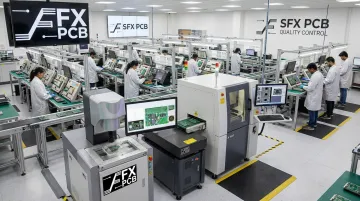
Multi-stage inspection with no board leaving untested:
- 100% electrical testing on every bare board before assembly — standard, not optional
- AOI, X-ray inspection, ICT, and Functional Circuit Testing (FCT) with custom test fixtures built to customer specifications
- Six-stage inspection process including SPI and 3D AOI
DFM analysis included on every order — not an upsell:
- Free DFM/DFA analysis on every order, reviewing Gerber files, drill files, and BOM for spacing violations, annular ring issues, and sourcing risks
- DFM review occurs before fabrication begins, with findings delivered to the customer for approval
Fast turnaround backed by local supply chain depth:
- Prototype assembly in as little as 24 hours once components are confirmed available
- Access to 600,000+ local component stock in the Shenzhen manufacturing ecosystem for rapid BOM completion
- BOM review with alternative component recommendations for long-lead or at-risk parts (customer approval required before any substitution)
Prototype to mass production with no supplier transition:
- Minimum order quantities starting at 5 pieces for prototypes
- Full mass production capacity — scale up without changing suppliers or re-qualifying vendors
- Same DFM team, test fixtures, and quality controls from first article through high-volume production
Environmental protection for harsh-use applications:
- Parylene nano-vacuum coating (IPX-8 rated, 5–30μm thickness, biocompatible) for moisture-critical applications
- Conformal coating available for medical, outdoor, automotive, and consumer electronics where chemical or humidity exposure is a concern
Conclusion
The manufacturer you choose shapes your product's outcome — from first prototype to production at scale. Four factors drive that decision:
- Certifications: ISO9001, ISO13485, IPC-A-610 — these reflect process discipline, not just paperwork
- Testing infrastructure: AOI, X-ray, and functional testing catch failures before they reach the field
- DFM capability: A thorough review upfront prevents costly redesigns downstream
- Scalability: The ability to move from 10 boards to 10,000 without switching suppliers
That said, this evaluation isn't one-time. As volumes grow, designs become more complex, or compliance requirements expand into new markets, your manufacturer's capabilities need to keep pace. The partner who gets your prototype to market must also be able to support you at full production scale — that continuity carries real risk mitigation value beyond any unit cost savings.
Frequently Asked Questions
How much does custom PCBA cost?
Custom PCBA costs depend on board complexity (layer count, component density), order quantity, assembly method (SMT, THT, or mixed), and testing requirements. Turnkey pricing bundles BOM procurement, assembly, and testing — but prototype runs carry significantly higher per-unit costs than production volumes due to setup and NRE fees.
How do you check if a PCB design is manufacturable?
A DFM analysis checks component spacing, trace clearances, footprint accuracy, and thermal management before production starts. SFX PCB flags and documents all DFM issues upfront — before a single board is cut — so problems are resolved before they affect yield.
What is the difference between PCB and PCBA?
A PCB is the bare substrate with copper traces and pads — non-functional on its own. A PCBA is the fully populated and soldered board with all components attached and verified. Only the PCBA is ready for deployment in a finished product.
What certifications should a PCBA manufacturer have?
At minimum: ISO 9001 for quality management, IPC-A-610 Class 2 or Class 3 for assembly workmanship, and RoHS/REACH compliance for environmental safety. Add ISO 13485 for medical device applications. Ask for auditable certificates — not just logos.
What is DFM analysis and why does it matter?
DFM is a pre-production design review that catches spacing errors, footprint mismatches, and thermal issues before they become assembly defects. Fixing problems at the design stage costs a fraction of what rework or scrap costs once production begins — which is why SFX PCB includes free DFM analysis on every order.
Can one PCBA manufacturer handle both prototypes and mass production?
Yes — and it matters more than most buyers realize. Switching manufacturers mid-development resets DFM learning, adds qualification time, and introduces yield risk. Choosing a scalable partner from the start lowers total program cost and reduces delivery risk across the full product lifecycle.