Introduction
A delayed PCB assembly can freeze an entire product launch. When you're racing toward an investor demo, EVT milestone, or emergency replacement shipment, waiting 3–4 weeks for assembled boards simply isn't viable. Turnaround time has moved from a secondary consideration to a primary procurement criterion.
Quick-turn PCB assembly compresses that timeline to anywhere from 24 hours to 7 days, depending on board complexity and component availability. What separates the providers that actually deliver from those that don't comes down to a few measurable factors.
This article compares five quick-turn PCBA providers — Sierra Circuits, SFX PCB, PCBWay, FastTurn PCBs, and EBest Circuit — across actual turnaround commitments, testing infrastructure, industry certifications, and the ability to scale from prototype to production.
Key Takeaways
- Quick-turn PCBA delivers assembled boards in 24 hours to 7 days, versus the weeks typical of standard production
- Key selection criteria: verified turnaround speed, testing depth (AOI, X-ray, FCT), certification match, and prototype-to-production scalability
- US-based providers offer faster domestic shipping — China-based providers with US offices can close much of that gap at lower cost
- The five providers below were selected for documented turnaround commitments, verified certifications, and breadth of testing coverage
- SFX PCB stands out with 24-hour assembly, free DFM review, IPC-A-610 Class 2/3 inspection, and seamless prototype-to-production scaling
What Is Quick-Turn PCB Assembly and Why Does It Matter?
Quick-turn PCB assembly is a service model where boards are fabricated, assembled, and tested on an accelerated schedule — typically 24 hours to 7 days depending on board complexity, layer count, and component availability. For engineers and product teams racing toward a launch date, a demo, or a field fix, that compressed timeline is often the difference between hitting a milestone and missing it.
Core Use Cases
Quick-turn isn't just for emergencies. The most common scenarios where it genuinely matters:
- Early-stage prototyping — EVT/DVT builds where design feedback needs to be fast
- Design validation — confirming that a schematic change actually works before committing to volume
- Investor or customer demos — functional boards needed on a fixed date
- Emergency replacements — field failures or end-of-life component swaps
- Rapid iteration — cycle through 2–3 design spins in the time standard lead times allow for one
What Actually Affects Lead Time
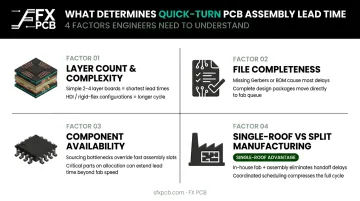
Speed commitments on paper can look identical across providers. What separates a genuine 48-hour build from one that quietly slips to day five comes down to a handful of operational realities:
- Layer count and board complexity — simple 2–4 layer rigid FR-4 boards qualify for the shortest lead times; HDI, rigid-flex, and high-layer-count boards add lamination cycles that extend timelines
- File completeness — missing Gerbers, incomplete BOMs, or absent pick-and-place files are the most common cause of delays in quick-turn projects
- Component availability — even a 24-hour assembly slot is irrelevant if a critical component has a 6-week lead time. An ECIA August 2023 sentiment survey showed broad improvement but flagged Memory ICs and Analog/Linear ICs as persistent exceptions
- Single-roof vs. split manufacturing — providers that handle fabrication and assembly in-house eliminate the handoff delay that occurs when two separate vendors are involved
Top Quick-Turn PCB Assembly and Testing Providers Compared
The providers below were evaluated on documented turnaround commitments, testing infrastructure, certifications, and scalability — not marketing claims alone.
Sierra Circuits
US-based (Sunnyvale, CA), operating since 1986. Sierra specializes in rapid prototype fabrication and assembly for IoT, aerospace, medical, and defense clients, with online quoting through their Turnkey Pro platform.
The domestic manufacturing advantage is real: faster shipping, no import duties, and engineering support around the clock. Sierra verifies up to 30 layers with 0.002-inch trace/space capability, and their Turnkey Pro service covers fabrication, component procurement, and assembly from a single interface.
| Attribute | Details |
|---|---|
| Turnaround Time | 24 hours for bare boards (1–6 layers); full turnkey assembly via Turnkey Pro in as fast as 5 days |
| Certifications | ISO 9001:2015, ISO 13485:2016, AS9100D, ITAR, UL, IPC Class 2/3 |
| Testing Capabilities | DFM/DFT review on every order; flying probe testing available; functional test available |
Best for: Teams requiring US domestic manufacturing, ITAR compliance, or aerospace/defense certifications.
SFX PCB
China-based full-service manufacturer (Shenzhen) with a US office in Plano, TX. SFX PCB serves global brands across medical, automotive, industrial automation, consumer electronics, and telecom — with end-to-end services spanning bare board fabrication through turnkey assembly.
Boards can be assembled from 24 hours once components are confirmed. Free DFM/DFA analysis runs on every order before production begins — the engineering team reviews Gerbers, flags issues, and reports findings before a single board is built.
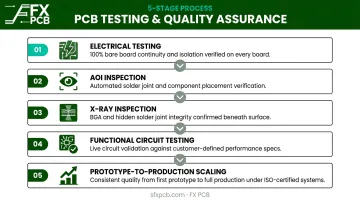
Testing is comprehensive and applied as standard:
- 100% electrical testing on every bare board before assembly
- AOI for solder joint and placement verification
- X-ray inspection for BGA and hidden joint evaluation
- Functional Circuit Testing (FCT) per customer specifications
- Prototype-to-production scaling under the same roof, same process documentation, and ISO-certified quality systems — no re-qualification when moving from 5 boards to 5,000
Access to 600k+ local component stock in Shenzhen reduces sourcing delays, which are a more common bottleneck than assembly capacity. For parts outside local stock, the team works alternative sourcing channels and presents options with customer approval before substituting anything.
| Attribute | Details |
|---|---|
| Turnaround Time | Assembly from 24 hours once parts are confirmed; prototype to production scaling without re-qualification |
| Certifications | ISO 9001, ISO 14001, ISO 13485, IPC-A-610 Class 2/3, RoHS, REACH, UL |
| Testing Capabilities | 100% electrical testing on bare boards, AOI, X-ray, FCT; free DFM/DFA on every order |
Best for: Teams needing a single partner from prototype through volume production, medical-grade or industrial-grade assemblies, and buyers who want DFM support built into the process rather than billed separately.
PCBWay
China-based online PCB and PCBA platform serving engineers, hobbyists, and businesses globally. PCBWay is well-known for transparent online quoting, low MOQ, and broad material options.
Assembly lead time officially runs 2 days to 3 weeks depending on order complexity and component sourcing. AOI is standard; X-ray and functional testing are available with additional charges. PCBWay's assembly facilities carry ISO 9001, ISO 13485, and IATF 16949 claims on their production pages — buyers in regulated industries should verify certificate status directly before relying on these for compliance purposes.
| Attribute | Details |
|---|---|
| Turnaround Time | Assembly: 2 days to 3 weeks depending on complexity and parts availability |
| Certifications | ISO 9001; ISO 13485 and IATF 16949 listed for production facilities — verify directly for regulated applications |
| Testing Capabilities | AOI standard; X-ray and functional testing available at additional cost |
Best for: Budget-conscious prototype teams with straightforward designs where absolute lowest per-unit cost is the priority over deep certification assurance.
FastTurn PCBs
Guangzhou-headquartered provider (with Dongguan PCB production base) specifically oriented around 24–72 hour prototype turnaround for US clients. Full turnkey offering covers fabrication, SMT and through-hole assembly, and inspection — with dedicated fast-turn production lines separate from standard queues.
Kitting models are flexible: turnkey, consigned, or hybrid. Board type support includes rigid, flex, and rigid-flex. The provider's quick-turn service targets engineers who need rapid iteration without managing multiple vendors.
| Attribute | Details |
|---|---|
| Turnaround Time | 24 hours for simple 2–4 layer bare boards; 24–72 hours for assembled prototypes with in-stock components |
| Certifications | ISO 9001, ISO 13485, IATF 16949, ISO 14001, ISO 45001, UL, IPC-A-610 Class 2/3, RoHS |
| Testing Capabilities | AOI, X-ray, functional testing available; DFM engineering review before production |
Best for: Engineers prioritizing the fastest assembled prototype timeline with flexible kitting options and no need for US domestic manufacturing.
EBest Circuit (Best Technology / BestPCBs)
Shenzhen-based manufacturer founded in 2006, with 260,000 sq ft monthly production capacity and shipments to 80+ countries. Serves automotive, medical, industrial, and telecom sectors with a strong emphasis on volume scalability and regulatory compliance.
EBest's most notable strength is certification breadth: IATF 16949, ISO 13485, AS9100D, and ISO 9001 are all claimed simultaneously, covering automotive, medical, and aerospace requirements in a single supplier. An 8-stage QC process with a provider-claimed 99.95% yield rate completes the picture; buyers should treat these figures as provider-claimed and verify active certificate status directly.
| Attribute | Details |
|---|---|
| Turnaround Time | 24 hours for small-batch urgent orders; 3–5 days for medium-to-high volume |
| Certifications | IATF 16949, ISO 9001:2015, ISO 13485:2016, AS9100D, UL, RoHS/REACH (provider-claimed — verify validity directly) |
| Testing Capabilities | 8-stage QC including AOI, X-ray, functional testing, environmental testing; full traceability for medical |
Best for: Teams with multi-industry compliance requirements at volume scale, particularly automotive (IATF 16949) or aerospace (AS9100D) programs.
How to Choose the Right Quick-Turn PCBA Provider
Match Certifications to Your Industry First
A 24-hour turnaround provider without ISO 13485 is the wrong choice for a medical device project, regardless of price. The same logic applies to IATF 16949 for automotive and AS9100D for aerospace. Before evaluating speed or cost, confirm:
- Active status: Listed certifications and audited certifications are different things — verify the current scope.
- Assembly coverage: Some providers hold certifications only for their bare-board facility, not assembly operations.
- Product class alignment: IPC-A-610 Class 2 and Class 3 have distinct acceptance criteria that affect yield and cost.
Evaluate Testing Depth, Not Just Testing Claims
The minimum acceptable testing stack for any quick-turn order with production intent:
- AOI — catches solder and placement defects visually
- X-ray — essential for BGAs and other hidden joints
- FCT — confirms the board actually functions as intended
- 100% electrical testing on bare boards — prevents defective substrates from entering assembly
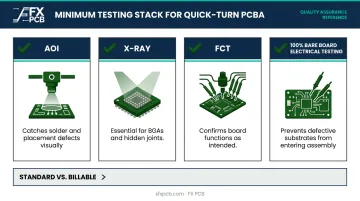
Not every quick-turn provider includes all four. Know which are standard versus billable on request — that distinction directly affects your total landed cost.
Factor in Total Cost, Not Just Per-Unit Price
US-based providers carry higher per-unit costs but eliminate import duties and reduce shipping time. China-based providers with US offices or strong logistics partnerships can close much of the communication and delivery gap. When comparing:
- Include shipping cost and transit time in the total landed cost calculation
- Factor in rework risk — a missed DFM issue caught late costs far more than the price difference between providers
- Consider re-qualification cost if you plan to scale — switching suppliers mid-program triggers requalification work that can delay your program by weeks
Conclusion
The right quick-turn PCBA partner is defined by the intersection of speed, testing depth, certification alignment, and supply chain reliability. The fastest bare-board turnaround claim means little if the assembly testing is shallow, the certifications don't match your industry, or component sourcing delays override every speed advantage.
- Regulated industries (medical, automotive, aerospace): prioritize certification depth and verify active audit status
- Startups and R&D teams: weight DFM support, prototype flexibility, and the ability to scale without switching suppliers
- Budget-conscious teams: compare total landed cost including shipping, rework risk, and re-qualification overhead — not just the quote
SFX PCB offers IPC-A-610 Class 2/3 certified assemblies, 24-hour turnaround once parts are confirmed, free DFM review on every order, and a clear path from prototype to mass production. With over 15 years of delivery across medical, automotive, and industrial sectors, the team is equipped to support both early-stage builds and high-volume runs.
To get started, reach out directly:
- Email: info@sfxpcb.com
- US Office (Plano, TX): (+1) 510-345-5000
Frequently Asked Questions
What is the typical turnaround time for quick-turn PCB assembly?
Quick-turn PCBA typically ranges from 24 hours for simple bare boards to 3–7 days for fully assembled prototypes. The exact timeline depends on layer count, board complexity, component availability, and whether fabrication and assembly are handled under one roof or split between vendors.
What testing methods should I expect from a quick-turn PCBA provider?
The standard testing stack includes AOI for solder joint and placement verification, X-ray for hidden joints like BGAs, and Functional Circuit Testing (FCT) to confirm board operation. Not all quick-turn providers include all three as standard — confirm what's included versus what's billed separately before placing an order.
How do I choose between a US-based and overseas quick-turn PCB assembly provider?
US-based providers offer faster domestic shipping and real-time communication without time-zone delays. Overseas providers with US offices can deliver comparable quality at lower cost. Factor in budget, delivery urgency, ITAR requirements, and import duties when making the call.
Does quick-turn PCB assembly support complex boards like HDI or rigid-flex?
Many providers offer the fastest lead times on standard rigid FR-4 boards. HDI, rigid-flex, and high-layer-count designs can be handled on quick-turn schedules but typically add 1–5 days due to additional lamination steps and specialized material handling.
What files do I need to submit to start a quick-turn PCBA order?
You'll need Gerber or ODB++ files for fabrication, a complete BOM with manufacturer part numbers, and a pick-and-place file with component coordinates and polarity. Incomplete or mismatched files are the most common cause of delays — providers like SFX PCB perform a free DFM/DFA review to catch issues before production begins.
Can quick-turn PCB assembly handle both prototype and production volumes?
Most quick-turn providers specialize in prototypes and low-volume runs. Full-service manufacturers like SFX PCB can scale from a single prototype to high-volume production under the same certifications and process controls — no supplier switching or re-qualification required.