
Introduction
Launch windows don't wait. In electronics product development, being three weeks late to market isn't just an inconvenience — according to IHS Markit data cited by Supply & Demand Chain Executive, a product introduction 9 to 12 months behind schedule can cost 50% of anticipated product revenue, with delay announcements reducing shareholder value by roughly 12%.
Every PCB vendor promotes rapid assembly. The question engineers and product managers actually face is whether faster hardware delivery changes development outcomes — and it does, when the advantages are applied deliberately.
This article breaks down what rapid PCB assembly improves, which business outcomes it protects, and when its advantages are strongest.
Key Takeaways
- Rapid PCB assembly cuts turnaround from weeks to days, enabling faster design iteration within a single sprint
- Early physical validation catches design and manufacturability errors when fixes are cheap, not after production commitments are made
- Consolidated sourcing and assembly under one partner eliminates handoff delays that project management alone can't prevent
- The payoff is greatest for teams under time pressure, entering regulated markets, or scaling from prototype to production
- Speed doesn't require a quality trade-off — IPC-A-610 Class 2/3 inspection standards apply to quick-turn orders the same as standard builds
What Is Rapid PCB Assembly?
Rapid PCB assembly is an accelerated manufacturing model where boards move from submitted design files to fully assembled, tested units in days rather than weeks. The practical range — supported by industry benchmarks from Sierra Circuits, Foxtronics, and Sunstone — is 24 hours to approximately 7 days, depending on board complexity, component availability, and BOM completeness.
- Standard rigid boards (1–6 layers): As fast as 24–48 hours once components are confirmed in stock
- Higher complexity or rigid-flex boards: Typically 5–8 days with assembly included
- Boards with incomplete BOMs or DFM issues: Add time for resolution before the clock starts
Where It's Most Commonly Applied
Rapid assembly delivers the most value in targeted, time-sensitive scenarios:
- Prototype validation — Getting real hardware into engineers' hands to confirm electrical performance and assembly reliability
- New Product Introduction (NPI) — Building initial units for functional testing, compliance pre-checks, and investor demonstrations
- Design iteration — Running multiple board revisions within a compressed development sprint
- Urgent small-batch production — Emergency replacement or bridging scenarios in medical, industrial automation, automotive, and IoT applications
In each case, the goal is the same: turn design assumptions into physical test evidence quickly enough that problems surface before they become expensive to fix.
Key Advantages of Rapid PCB Assembly
Advantage 1: Compressed Time-to-Market Through Faster Iteration
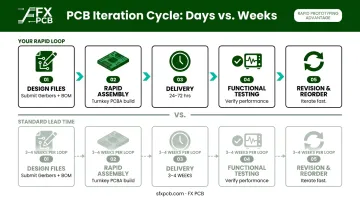
The biggest time losses in electronics development don't happen during fabrication. They accumulate across design → build → wait → test → revise cycles. Each iteration that takes three to four weeks using standard lead times consumes calendar space that can't be recovered.
Rapid assembly breaks this loop. A team with clean design files and a confirmed BOM can receive assembled, tested boards within 24–72 hours, run functional verification, identify needed changes, and reorder — completing a full revision cycle in the time standard lead times allow for a single build.
In fast-moving categories like IoT devices, automotive electronics, and consumer hardware, the team that reaches validated hardware first has a structural advantage. They enter investor conversations, regulatory submissions, and retailer timelines with physical evidence instead of simulations.
Why this matters competitively:
Teams still waiting on boards fall a full iteration behind — and in a competitive launch window, that gap rarely closes.
KPIs this directly affects:
- Development cycle duration
- Number of design iterations completed before launch
- Time from concept to validated prototype
- Actual launch date versus plan
When this advantage is strongest: Teams racing against a known competitor launch window, startups approaching a funding milestone, or any project where a delayed launch has direct revenue or contract consequences.
Advantage 2: Early Design Validation Prevents Expensive Late-Stage Rework
Rapid PCB assembly enables teams to validate not just electrical performance, but assembly reliability and manufacturability — early in the design cycle, when changes are inexpensive.
NIST's manufacturing cost research confirms the underlying principle: design changes cost significantly more in later stages of product development. On a PCB program, "later" means after tooling decisions, component purchase orders, and production programming are complete. At that point, a layout error doesn't just require a board revision — it can mean scrapped inventory, halted production runs, new inspection and test cycles, and rescheduled launch gates.
What Early Validation Actually Catches
Fast-turnaround prototype builds, when combined with proper inspection, reveal failure modes that simulation often misses:
- Component placement and clearance issues that cause assembly defects
- Stack-up and via assumptions that don't hold under real thermal or mechanical conditions
- Footprint mismatches between design libraries and actual components
- Solder joint reliability problems in high-density areas
SFX PCB's free DFM analysis — performed before a single part is ordered — flags manufacturability risks at the point where they're cheapest to fix: before fabrication begins. The review covers spacing between components, annular ring dimensions, and footprint accuracy against the actual BOM. Issues that would cause a board respin get resolved at the design stage instead of after assembly.
For prototype orders, SFX PCB applies AOI, X-ray inspection (critical for BGA components), and functional testing regardless of quantity — the same inspection rigor as production runs.
KPIs this directly affects:
- First-pass yield rate (measured against IPC-7912A DPMO methodology)
- Rework and scrap costs
- Number of design spins before production release
- Engineering change order frequency post-launch
When this advantage is strongest: Complex high-density boards, designs entering regulated markets (medical, automotive) where field failures carry serious consequences, or any project where mass production tooling costs make post-launch design changes prohibitively expensive.
Advantage 3: Consolidated Supply Chain Eliminates the Most Common Source of Delay
Multi-vendor PCB assembly — where design, fabrication, component sourcing, and assembly are managed separately — introduces handoff delays and accountability gaps that project management alone cannot eliminate. When the fab is waiting on components, and the assembler is waiting on the fab, and the engineer is waiting on all three, delays compound undetected until they become a schedule crisis.
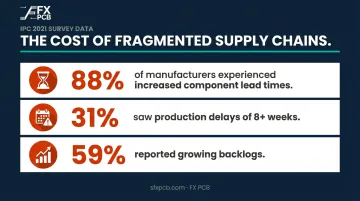
IPC's 2021 global survey documented how widespread this problem is: 88% of electronics manufacturers experienced increased component lead times, 31% saw production delays of 8 weeks or more, and 59% reported growing backlogs. Fragmented vendor structures make teams maximally exposed to these dynamics.
How Consolidated Assembly Changes This
A single-source rapid assembly provider owns the full scope: component procurement, fabrication scheduling, assembly, and testing. When a BOM item is unavailable, the same team building the board identifies the problem and sources alternatives directly.
That's a meaningful difference from the standard model, where a shortage surfaces as a surprise delay from a third-party parts broker — often days after the impact is already locked in.
SFX PCB manages component procurement internally as part of turnkey assembly, with access to 600k+ locally stocked components and an experienced sourcing team that actively identifies alternatives when lead times are extended. SFX PCB requires customer approval on all substitutions before use — the speed advantage doesn't come at the cost of transparency.
The prototype-to-production transition is where consolidated sourcing pays an often-overlooked dividend. The manufacturing knowledge, stack-up records, and quality data built during prototyping carry directly into the production build — no re-qualification, no onboarding a new manufacturer to reverse-engineer your previous partner's decisions.
KPIs this directly affects:
- Supplier lead time variability
- Total procurement-to-delivery cycle time
- Schedule adherence rate
- Prototype-to-production transition time
Complex BOMs with many component types benefit most from this model — particularly projects on aggressive timelines or teams moving from prototype to production who can't absorb re-qualification mid-program.
What Happens When Rapid Assembly Is Skipped
Choosing standard lead times during critical development phases doesn't just slow things down — it compresses the time available for testing and iteration. Teams end up making production decisions based on incomplete data because the hardware evidence arrived too late to act on it.
The consequences compound:
- Design errors that would have been caught in a fast prototype cycle survive into production, where fixing them means halting runs, scrapping inventory, or issuing post-launch ECOs
- Firmware teams, testing teams, and procurement leads all get blocked — not from a single failure, but from accumulated wait time at every handoff
- Parallel development tracks become impossible when each iteration consumes three to four weeks
The math rarely favors cutting corners on prototyping speed. The premium for expedited assembly is consistently smaller than the revenue hit from a delayed launch or the cost of a post-production design change — and far smaller than watching a competitor deliver a validated board to your customer first.
How to Get the Most Value from Rapid PCB Assembly
Rapid assembly delivers its best results when it's built into the development workflow from day one — not called in as a last resort after standard lead times fall short.
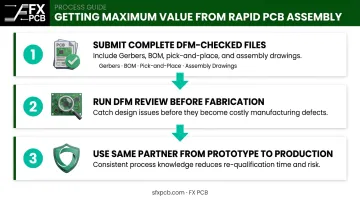
Three conditions make rapid assembly deliver its highest return:
Submit complete, DFM-checked files. Incomplete Gerber packages, BOMs missing manufacturer part numbers, or pick-and-place files with orientation errors are the single largest source of self-inflicted delays. A complete submission includes Gerbers, BOM with manufacturer part numbers and approved alternates, pick-and-place data, and assembly drawings.
Run DFM review before fabrication starts. A board that assembles quickly but fails first-pass inspection due to an avoidable layout issue isn't a rapid assembly success. The DFM review that SFX PCB performs before any parts are ordered exists specifically to prevent this scenario.
Use the same partner from prototype through production. The manufacturing knowledge built during prototyping (stack-up decisions, component qualifications, inspection records) should transfer directly into the production build. SFX PCB's structure supports this continuity: the same capabilities and quality standards that apply to a 5-piece prototype order scale directly to high-volume production, with no supplier transition required.
One practical step that prevents the most common unexpected delay: confirm component availability on all BOM items before submitting the order. If a critical component is on backorder, no amount of fast assembly closes that gap — catching it early keeps your timeline intact.
Conclusion
The real payoff of rapid PCB assembly isn't just speed — it's where that speed lands. Shorter iteration cycles mean teams reach validated hardware before budgets erode. Earlier design validation catches problems when fixing them costs hours, not weeks. And tighter supply chain control removes the scheduling unpredictability that derails most hardware timelines.
Those advantages are strongest when rapid assembly is treated as a deliberate part of the development workflow — applied consistently from prototype through production with a partner who maintains the same quality standards regardless of turnaround time. SFX PCB's IPC-A-610 Class 2/3 certification, free DFM analysis, and prototype-to-production scaling without switching suppliers mean one consistent process from first build to full production run.
Frequently Asked Questions
Frequently Asked Questions
What are the benefits of rapid PCB assembly services?
Rapid PCB assembly compresses iteration cycles, enables earlier design validation when changes are cheapest to make, and reduces the risk of a late launch. Working with an IPC-certified partner ensures these speed gains don't trade off against board quality or inspection rigor.
How fast can a rapid PCB assembly service deliver assembled boards?
Turnaround times typically range from 24 hours to 7 days depending on board complexity, layer count, and component availability. Simple rigid boards with a confirmed BOM and complete design files can be assembled and shipped within 24–48 hours; more complex designs or those requiring component sourcing will take longer.
Does quick-turn PCB assembly compromise board quality?
Reputable rapid assembly providers maintain the same IPC-A-610 inspection standards, AOI, X-ray, and functional testing on quick-turn orders as on standard builds. At SFX PCB, 100% electrical testing on bare boards and full PCBA inspection apply regardless of turnaround time — speed comes from prioritized workflows and local component stock, not from skipping quality steps.
What factors affect turnaround time in rapid PCB assembly?
The main variables are board complexity (layer count, via types, component density), design file completeness, BOM accuracy, and component availability. Confirming all BOM items are in local stock before submission removes the most common cause of unexpected delays.
What is the difference between quick-turn and standard PCB assembly?
Standard PCB assembly typically involves 2–4 week lead times optimized for cost efficiency at volume. Quick-turn assembly prioritizes speed through prioritized scheduling, local component stock, and parallel process handling — at a modest price premium that is typically a fraction of the cost of a delayed product launch.
How can I prepare my design files to speed up PCB assembly?
Submit Gerber files, a BOM with manufacturer part numbers and approved alternates, pick-and-place files, and assembly drawings in one package. Run a DFM check before submission — through your design tools or your assembly partner's free DFM service — to catch issues before they delay your build.