
In the modern era, where electronics are an integral part of our lives, the unsung heroes are often the Printed Circuit Boards (PCBs) – those unassuming green (or sometimes red) rectangles that power our devices. The creation of these intricate PCBs involves a multifaceted process, and one of the most crucial stages in their fabrication is PCB drilling. In this comprehensive article, we’ll delve into the world of PCB drilling, exploring its significance, the mechanics behind it, the various tools, pcb drilling machines involved, and the intricate process that transforms a plain board into a functional circuit.

As a fast turnaround or quick-turn PCB Assembly Manufacturer /factory in Shenzhen China, FX PCB is able to fulfill orders in a fast delivery time with our modern technologies used in production.
Our factory carries out the assembly and installation of printed circuit boards to order. During the development and manufacturing process, constant quality control is carried out. We strictly follow your Gerber file and Bom list for your fast turnaround or quick turn PCBA projects, and we will also be glad to suggest you the alternative for your passive components to decrease your cost, but all replacement components need you to approve and make the final decision on whether you want to use them.
PCB drilling, in essence, is the art of creating precision holes in a PCB’s substrate, which is typically composed of fiberglass-reinforced epoxy. These holes serve as receptacles for component leads, vias, and pathways, ensuring the seamless flow of electricity and data. The exact placement and size of these holes are pivotal in the functionality of the final electronic device.
PCB drilling is no mere task of drilling holes; it’s a meticulous process that requires a keen eye for detail and precision. Here’s how it all comes together:
Before the drilling commences, the PCB’s design is loaded into a Computer-Aided Design (CAD) system. This digital blueprint provides precise coordinates for hole placement and size. The PCB is meticulously aligned, and reference points are established to ensure spot-on drilling accuracy.
The choice of drill bits is paramount. These bits, usually crafted from tungsten carbide or high-speed steel, come in various sizes, ranging from minuscule 0.1mm bits to more substantial options, tailored to the PCB’s design requirements.
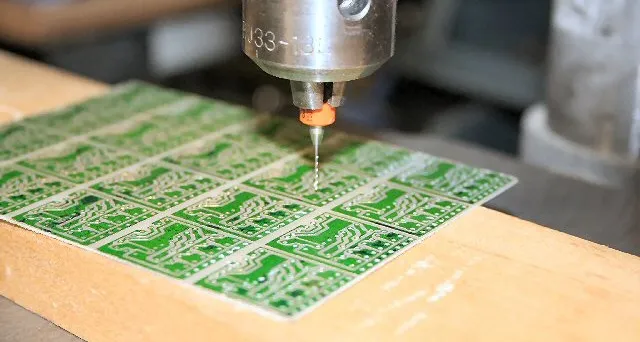
PCB drilling is primarily conducted with Computer Numerically Controlled (CNC) machines built exclusively for this purpose. The PCB is clamped securely on the machine’s bed, and the drill bits are loaded into the spindle, ready for action.
The CNC machine follows the design specifications with pinpoint accuracy. As the drill bits rotate at high speeds, they bore through the substrate, creating holes of precise size and depth. To prevent overheating of the drill bits and protect the PCB from damage, cooling systems are often employed.
Throughout the process, vigilant quality control measures are enacted to ensure that holes are drilled accurately and without any imperfections, such as burrs or fractures.
To meet the intricate demands of PCB drilling, a range of drill bits are employed. Some common types of drill bits include:
These are the go-to drill bits for standard PCB drilling tasks.
These specialized bits are used for routing out areas of copper on the PCB, typically for creating complex shapes or cutouts.
For drilling those minuscule holes and vias in high-density PCBs, micro-drills are essential.
Designed with a diamond-coated tip, these bits are reserved for drilling into ceramics and other hard materials.
The machinery used for PCB drilling varies from manual to fully automated CNC machines, depending on the specific design and production scale. The main types include:
Manual Drilling Machines:
Ideal for prototyping or low-volume production, these machines are manually operated by an operator.
Semi-Automatic Drilling Machines:
These machines strike a balance between manual control and automated positioning, ensuring precise hole alignment.
Fully Automatic CNC Drilling Machines:
High-precision powerhouses, these machines are deployed for large-scale PCB manufacturing. They execute complex drilling tasks with impeccable accuracy, following design specifications to the letter.
The process of PCB drilling is part of a broader PCB manufacturing workflow that unfolds as follows:
The PCB’s digital design is meticulously crafted using CAD software, determining the layout, component placements, and hole positions.
The substrate material, typically a copper-clad fiberglass-reinforced epoxy sheet, is meticulously prepared.
As described earlier, this is the stage where the PCB is secured to a CNC machine, and holes are precisely drilled according to the design.
The newly drilled PCB undergoes a thorough inspection, with any defects or misaligned holes rectified at this stage.
To enhance electrical connectivity between layers, the holes are often copper-plated.
The excess copper is etched away, revealing the desired copper traces and connections.
To protect the traces and provide labeling, the PCB is coated with a solder mask and silkscreen.
Before the PCB is deemed ready for use, it goes through a final inspection to ensure all specifications have been met.
The significance of PCB drilling cannot be overstated. PCBs serve as the backbone of nearly all electronic devices. They are responsible for creating the electrical connections that allow components to communicate and function in harmony. Without precision drilling, the integrity of the PCB would be compromised, leading to a myriad of issues, including faulty connections, short circuits, and potentially damaging electronic components.
Drilling accuracy directly affects the overall performance, reliability, and lifespan of the final product. For high-frequency and high-speed applications, such as those found in advanced electronics and communication devices, even the smallest deviation in hole placement or size can lead to signal degradation or complete failure.
Moreover, miniaturization is a constant trend in the electronics industry. As devices become smaller and more compact, the need for smaller and more precise holes increases. The drilling process must keep pace with these demands, which is why the use of advanced CNC machines and specialized drill bits has become the norm in PCB fabrication.
Computer Numerically Controlled (CNC) machines are at the forefront of PCB drilling technology. These machines are equipped with a range of advanced features that make them indispensable in modern PCB fabrication. Let’s explore the role of CNC machines in PCB drilling:
CNC machines are designed to deliver unparalleled precision and accuracy. They follow design specifications down to the micrometer, ensuring that holes are placed with exactitude. This is crucial for maintaining signal integrity in high-frequency PCBs and for accommodating the ever-shrinking components in modern electronics.
CNC machines operate at high speeds, making them incredibly efficient. They can drill multiple holes in a matter of seconds, vastly improving the overall productivity of PCB manufacturing.
In modern PCBs, complex drilling patterns are often required to create intricate connections and pathways. CNC machines can effortlessly handle these intricate designs, executing them with remarkable consistency.
By automating the drilling process, CNC machines significantly reduce the potential for human error. This ensures that the PCBs produced are of the highest quality and reliability.
CNC machines are versatile and can be used for both small-scale prototyping and large-scale production. This scalability makes them an ideal choice for PCB manufacturers of all sizes.
The world of electronics is ever-evolving, and PCB technology is no exception. PCB drilling has seen significant advancements over the years to keep pace with the increasing demands of the electronics industry. Some key developments in PCB drilling technology include:
As electronics continue to push the boundaries of speed and performance, PCBs need to keep up. High-speed drilling machines equipped with advanced spindles and control systems can precisely drill small holes at incredible speeds, making them ideal for high-frequency applications.
Laser technology has found its way into PCB drilling. Laser drills offer extreme precision and the ability to create smaller holes than traditional mechanical drills. They are especially valuable in advanced applications like microelectronics and aerospace.
Modern CNC machines often feature automated tool changers. This technology allows for a seamless transition between different drill bits during the drilling process, reducing downtime and improving overall efficiency.
Precision drilling often requires control over the depth of the holes. Advanced CNC machines can precisely control the depth of each hole, allowing for the creation of intricate vias and multilayer PCBs.
To prevent drill bit overheating and PCB damage, advanced cooling systems have been developed. These systems maintain the optimal operating temperature, even during high-speed drilling.
3D printing technology has found applications in creating custom drill templates. These templates provide a guide for drill bits, ensuring precision and repeatability in hole placement.
The integration of sophisticated software with CNC machines has improved the automation and accuracy of PCB drilling. Software can detect and correct errors in real-time, reducing the chances of defects.
The world of PCB drilling is a fascinating and dynamic one. It is a journey that begins with a digital design and ends with a fully functional circuit board, integrated into the electronic devices we rely on daily. PCB drilling is the core of this process, and its precision and accuracy are pivotal in ensuring that these devices perform reliably.
Advancements in PCB drilling technology are driven by the ever-evolving demands of the electronics industry. From high-speed drilling to laser technology and automated tool changers, these innovations are shaping the future of PCB fabrication.
As electronics continue to infiltrate every aspect of our lives, from smartphones and smart appliances to autonomous vehicles and IoT devices, the role of PCB drilling in shaping our technological landscape cannot be understated. It’s the art of PCB drilling that keeps our devices compact, powerful, and reliable, ensuring that the heart of electronics beats with unwavering precision.

I am Peter Gong. I have been working in PCB and PCBA industry for 15+ years now. I have been a part of the PCB revolution with my dedication to circuit board technologies and creative ideas. I write in FX PCB to impart my knowledge on PCB and PCBA for all circuit board lovers, manufacturers, and users.
WhatsApp us