Introduction
The calculus around PCB sourcing has shifted. Geopolitical tensions, post-pandemic port disruptions, and a tariff environment that changes quarter to quarter have pushed procurement managers and engineers to ask questions that felt settled a decade ago: where are our boards actually coming from, and what does that dependency really cost us?
Offshoring PCB fabrication made sense when labor arbitrage was the dominant cost driver. But the hidden costs — IP exposure, communication delays, defect-driven rework, and shipping unpredictability — are harder to ignore now. The US share of global PCB production fell from over 30% in 2000 to just 4% by 2020, while China captured 56% of global output. That concentration creates real supply chain risk — and it's reshaping how US teams evaluate sourcing decisions.
This article breaks down 7 concrete, operational advantages of domestic PCB fabrication — and what each one means for product quality, delivery schedules, and business risk.
TL;DR
- US PCB manufacturers operate under IPC-6012 and IPC-6013 standards that directly reduce defect rates and rework costs
- Domestic sourcing eliminates tariff exposure on PCB imports, which jumped from 10% to 25% under Section 301
- For defense, medical, and aerospace applications, domestic fabrication isn't just preferred — it's often a compliance requirement
- IP theft from overseas partners is a documented risk — US courts offer significantly stronger legal enforcement
- The DoD awarded $30M in 2024 to expand domestic PCB production — and capacity is actively improving
What Is Domestic PCB Fabrication?
Domestic PCB fabrication refers to the design, etching, lamination, and testing of printed circuit boards within the United States, under US regulatory and quality frameworks.
This is distinct from assembly or distribution. Fabrication is where the board itself is built — and it's the stage where most quality outcomes, IP exposure, and lead time variables are determined.
The decision to source domestically is a strategic one. It shapes lead times, IP security, regulatory compliance, and quality control — all before a single component is placed. The seven advantages below break down exactly why that decision matters.
7 Advantages of Domestic PCB Fabrication
Each advantage below connects to metrics that procurement managers, engineers, and supply chain leaders actually track: defect rates, lead times, cost predictability, compliance risk, and IP security.
Advantage 1: Adherence to Stringent IPC and ISO Quality Standards
US PCB manufacturers comply with IPC-6012 for rigid boards and IPC-6013 for flexible and rigid-flex boards. These standards define acceptance criteria that directly influence board reliability in deployed products.
Domestic manufacturers typically implement a layered quality stack:
- Laser direct imaging (LDI) for precise pattern transfer
- Automated optical inspection (AOI) to catch surface defects
- 100% electrical testing to verify continuity and isolation
- X-ray inspection for BGA and buried via integrity
The stakes are high when this stack isn't in place. In 2023, the FDA issued a correction for the HAMILTON-C6 ventilator after a circuit-board hardware issue created risk of sudden ventilation interruption — a direct example of what PCB-level failures cost in regulated applications.
IPC Class 2 vs. Class 3 matters here. Class 3 compliance is specified for high-reliability and performance-on-demand applications — defense, aerospace, life-critical medical. Boards sourced from less scrutinized supply chains often can't meet Class 3 requirements, which means re-qualification costs get discovered after the fact, not budgeted upfront.
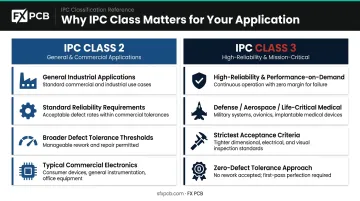
KPIs impacted: Defect rate (DPPM), first-pass yield, rework cost per board, field return rate
Advantage 2: Supply Chain Resilience and Tariff Insulation
Domestic fabrication removes the cost variables that have made overseas sourcing unpredictable: international freight rates, port congestion, import tariffs, and customs clearance delays.
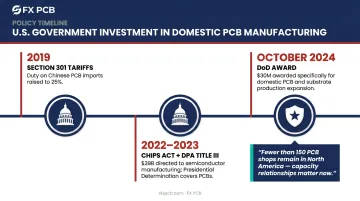
The tariff picture alone is significant. Printed circuits fall under HTS 8534.00.00, and USTR's Section 301 List 3 action raised the duty rate on Chinese imports from 10% to 25% in 2019. That's on top of base freight, insurance, customs brokerage, and inspection costs — none of which appear in an offshore factory quote.
Kearney's 2026 Reshoring Index improved from -115 to -86, but remained negative, meaning manufactured goods imports continued to rise. Reshoring is accelerating but hasn't eliminated offshore dependency — which means companies without domestic sourcing options remain exposed.
Domestic sourcing provides:
- Predictable lead times without customs clearance as a variable
- Smaller safety stock requirements without the risk of stockouts from shipping delays
- No tariff exposure on future policy changes
- Faster response to demand spikes or engineering change orders
KPIs impacted: Total landed cost per board, inventory carrying cost, on-time delivery rate, supply chain disruption frequency
Advantage 3: Robust Intellectual Property Protection
PCB designs represent real R&D investment. Gerber files, proprietary stackup configurations, and circuit schematics sent to overseas manufacturers — particularly in jurisdictions where IP enforcement is inconsistent — carry meaningful theft and unauthorized replication risk.
The US Trade Representative continues to flag China for trade secret and technology-transfer concerns in its annual Special 301 reports. The AMSC/Sinovel case — where alleged losses exceeded $800M and Sinovel ultimately paid $57.5M in restitution — illustrates the core problem: winning in a US court means little when the defendant's assets are overseas and enforcement is limited.
US manufacturing law provides meaningful protection throughout the fabrication process:
- NDAs are enforceable in US courts
- The Defend Trade Secrets Act (18 U.S.C. 1836) provides a federal civil remedy for trade secret misappropriation
- IP registration confers legal rights that can be acted on realistically
For companies in IoT, medical devices, or industrial automation — where proprietary circuit design is a genuine competitive differentiator — unauthorized replication can erase years of R&D advantage before a product ever reaches its second-generation release.
KPIs impacted: IP incident rate, legal exposure cost, competitive differentiation timeline, time-to-market for next-generation products
Advantage 4: Faster Turnaround and Shorter Lead Times
Domestic fabrication eliminates transcontinental shipping time and customs processing. Standard domestic lead times are measured in days, not weeks — and prototype turnarounds as fast as 24 hours are available from some manufacturers when design files are ready and board complexity allows.
For product development teams, this speed difference compounds across design iterations. A single revision cycle that takes three weeks instead of three days delays the next design review, pushes back qualification testing, and can cascade into a missed launch window.
When this matters most:
- During prototype iterations, where design changes require rapid board revision
- During product ramp-up, when tooling and process validation need multiple cycles
- In markets with short product refresh cycles, where time-to-market is a direct revenue variable
KPIs impacted: Prototype-to-production cycle time, days-to-ship, time-to-market for new designs
Advantage 5: Direct Communication and Real-Time Engineering Collaboration
Working with an overseas manufacturer means navigating 12-16 hour time zone gaps, language barriers, and delayed design change acknowledgments. Every iteration cycle absorbs that friction.
Proximity to a domestic manufacturer enables:
- On-site audits and facility visits without international travel costs
- Real-time DFM (Design for Manufacturability) feedback that catches design errors before production
- Same-day responses to engineering change orders
- Direct collaboration on stackup selection, via design, trace/space rules, and material choices
DFM review catches problems that would otherwise become expensive respins — insufficient annular rings, trace spacing violations, and stackup configurations that can't be fabricated to spec. The earlier these are caught, the cheaper the fix.
During prototype development and ramp-up, teams that can reach their manufacturer in real time typically resolve DFM issues in hours rather than days — a gap that directly affects how many revision cycles a schedule can absorb.

Advantage 6: Compliance Support for Defense, Medical, and Aerospace Applications
For companies in regulated markets, domestic fabrication is frequently a hard requirement, not a sourcing preference.
Defense and federal programs:
- Application-specific PCBs designed for USML defense articles are ITAR-controlled under Category XI(c)(2) — only manufacturers operating within the US regulatory framework can handle these
- CMMC (32 CFR Part 170) applies when PCB suppliers handle Federal Contract Information (FCI) or Controlled Unclassified Information (CUI)
- MIL-PRF-31032 and MIL-PRF-55110 establish performance requirements for military PCBs that require qualified domestic manufacturers
Medical device programs:
- FDA 21 CFR Part 820 purchasing controls flow down to PCB suppliers in medical device supply chains
- ISO 13485 QMS requirements are easier to validate and audit with a domestic partner operating under US regulatory oversight
Non-negotiable sectors: Defense, federal government contracting, FDA-regulated medical devices, and increasingly, critical infrastructure suppliers facing expanding supply chain security requirements.
Advantage 7: Government Incentives and Long-Term Domestic Capacity Investment
Federal investment is actively rebuilding domestic PCB capacity. The DoD awarded $30M in October 2024 specifically to expand domestic PCB and substrate production — a direct signal that national security policy and domestic fabrication capacity are linked.
The CHIPS and Science Act has directed $39B toward domestic semiconductor manufacturing and launched over $5B in R&D programs. While the primary focus is on advanced semiconductors, the broader electronics manufacturing ecosystem — including PCB fabrication — benefits from this investment through workforce development, advanced equipment adoption, and infrastructure upgrades.
A 2023 Presidential Determination under Defense Production Act Title III also specifically covered printed circuit boards and advanced packaging production capability — confirming that PCBs are considered a national defense priority.
What this means for sourcing decisions:
- Domestic manufacturers are investing in advanced equipment now
- Capacity is constrained — fewer than 150 PCB shops remain in North America, down from 200 in 2020
- Companies establishing domestic manufacturing relationships now will have better access to quality-verified partners before capacity tightens further
What Happens When Domestic Fabrication Is Overlooked
Over-reliance on non-certified overseas PCB fabrication creates compounding costs that rarely appear in the original sourcing decision:
Tariff exposure: Section 301 duties on HTS 8534.00.00 boards can add 25% to the cost of China-origin PCBs — a variable that makes multi-year cost modeling unreliable and end-product pricing difficult to defend.
Quality risk: Boards from suppliers without IPC-enforced QC arrive with higher defect rates. Rework, scrap, and re-inspection costs add up fast — wiping out the per-unit savings that made offshore sourcing attractive in the first place.
Regulatory exposure: Companies in defense, medical, and aerospace that rely on boards from non-certified suppliers face re-qualification costs, contract losses, and in some cases product recalls — each of which typically exceeds the full cost of sourcing compliant boards from the start.
IP risk: Without the enforceability of US courts and IP law, design theft may go undetected until a competitor is already shipping a cloned product. At that point, legal remedies are limited and recovery is slow.
Conclusion
The seven advantages of domestic PCB fabrication — quality standards, supply chain resilience, IP protection, speed, engineering collaboration, regulatory compliance, and government-backed capacity investment — aren't one-time wins. They compound across every product cycle.
Evaluating any PCB manufacturing partner — domestic or international — should center on the same measurable criteria: IPC-A-610 and ISO certifications, testing protocols (AOI, X-ray, 100% electrical testing), proven DFM capabilities, and responsive communication.
SFX PCB holds ISO9001, ISO13485, IPC-A-610 Class 2/3, and UL certifications, and maintains a US support office in Plano, TX — demonstrating that consistent quality and accessible communication can be delivered across manufacturing geographies. That said, for ITAR-controlled programs or applications requiring fully domestic fabrication, purpose-built US manufacturers remain the appropriate choice.
As tariff policy evolves and reshoring accelerates, companies that build relationships with quality-verified PCB partners now will be better positioned to respond. The suppliers you vet today determine how quickly you can adapt tomorrow.
Frequently Asked Questions
Are US-manufactured PCBs more expensive than overseas alternatives?
Per-unit fabrication costs may be higher domestically, but the total landed cost often favors domestic sourcing. When you factor in Section 301 tariffs (up to 25% on HTS 8534.00.00), international freight, customs brokerage, inspection, rework from higher defect rates, and delay-driven expedite fees, domestic sourcing frequently comes out cost-competitive or superior on a lifecycle basis.
What IPC and ISO certifications should I require from a PCB manufacturer?
For bare PCB fabrication, require IPC-6012 (rigid boards) or IPC-6013 (flex/rigid-flex), and IPC-A-600 for inspection acceptability. For assembly quality, specify IPC-A-610 Class 2 or Class 3. ISO9001 covers quality management, ISO13485 is required for medical device supply chains, and UL certification matters for product safety compliance.
How does domestic PCB fabrication improve supply chain resilience?
Domestic sourcing removes exposure to international shipping delays, customs bottlenecks, and tariff volatility. It enables smaller safety stock without stockout risk, more predictable lead times for production scheduling, and faster response to demand changes or engineering revisions — all of which improve on-time delivery performance.
Is IP theft a real risk when manufacturing PCBs overseas?
Yes, and it's well-documented. The USTR's annual Special 301 reports continue to flag China for trade secret and technology-transfer violations. US courts offer significantly stronger IP protections, and the Defend Trade Secrets Act provides a direct federal civil remedy with no equivalent in most offshore jurisdictions.
Which industries benefit most from domestic PCB fabrication?
Defense and aerospace (ITAR, MIL-PRF compliance), medical devices (FDA 21 CFR Part 820, ISO13485), and automotive (IPC Class 3, traceability requirements) see the highest compliance-driven impact. Any company with proprietary circuit designs, tight delivery requirements, or customers who require Made in USA sourcing also benefits materially from domestic fabrication.
What is the CHIPS and Science Act and how does it affect PCB manufacturing?
The CHIPS and Science Act directed $39B toward domestic semiconductor manufacturing and $5B+ in R&D, strengthening the broader electronics ecosystem. For PCB manufacturers specifically, the DoD's $30M 2024 award and DPA Title III Presidential Determination directly target domestic PCB and substrate production capacity expansion.