
Manufacturers who understand where these forces are converging — and who act before they're forced to — will compress timelines, reduce costs, and outpace competitors still reacting to last year's disruptions. Those who wait for clarity will find they're already behind.
This article breaks down the five dominant trends reshaping electronics manufacturing in 2025, what's driving them at a structural level, and what manufacturers need to do differently to stay competitive.
Key Takeaways
- AI and automation are moving from pilot programs to production-floor deployment, with measurable gains in defect rates, downtime, and throughput
- Tariff-driven supply chain restructuring is forcing manufacturers to diversify sourcing and explore nearshoring options
- Sustainability compliance (RoHS, REACH, and emerging PFAS restrictions) is a baseline market requirement, not a competitive edge
- Miniaturization is pushing PCB complexity higher, making AOI, X-ray, and functional testing non-negotiable at every stage
- A widening skills gap is constraining capacity at exactly the moment manufacturers are ramping up automation investment
Five Key Trends Shaping Electronics Manufacturing in 2025
These five trends didn't emerge independently. They reflect intersecting market, regulatory, and technological pressures — and each one points to a different area where manufacturers need to make decisions now.
AI and Smart Manufacturing Integration
AI has crossed from experimentation into mainstream manufacturing operations. Deloitte's 2025 Smart Manufacturing Survey of 600 manufacturing executives found 88% expect smart manufacturing investment to continue or increase in the next fiscal year, with 78% already allocating more than 20% of improvement budgets to it. That's not a pilot program posture — that's infrastructure spending.
In electronics specifically, the gains are quantifiable. The WEF's 2025 Global Lighthouse Network reported that Valeo's Shenzhen facility used AI-powered closed-loop inspection to reduce finished-goods defect rates by 45.9% and market failure rates by 93.0%. Siemens Erlangen cut time-to-market by 40% and reduced electrical-test false positives by 51% using AI algorithms and digital twins.
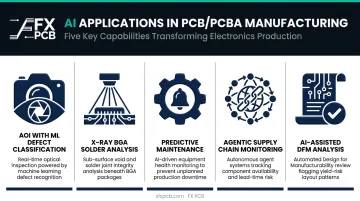
Key AI applications gaining traction in PCB and PCBA manufacturing:
- Automated optical inspection (AOI) with machine learning-enhanced defect classification
- X-ray analysis for hidden solder joint integrity (BGA, QFN packages)
- Predictive maintenance — Foxconn Vietnam reduced unplanned downtime by 90% using an LLM-enabled machine-failure system
- Agentic AI for supply chain risk monitoring and autonomous procurement decisions
- AI-assisted DFM analysis to catch design errors before boards are run
Manufacturers like SFX PCB deploy AOI, X-ray inspection, and SPI systems across their assembly lines — the kind of quality infrastructure that positions them to integrate AI-enhanced analytics as the tooling matures.
Supply Chain Diversification and Tariff Pressures
US tariffs on Chinese imports — covering goods across multiple Section 301 lists — combined with 2025 IEEPA actions affecting Canada and Mexico, have forced electronics manufacturers to fundamentally rethink procurement strategy.
The Consumer Technology Association modeled tariff-driven price increases of 31% for smartphones, 32% for monitors, 34% for laptops, and 69% for gaming consoles. That cost pressure cascades directly into component sourcing decisions upstream.
The response is visible in sourcing behavior. IPC's March 2025 supply chain report found 61% of electronics manufacturers were considering renegotiating supplier contracts, 31% invested in automation, and 28% switched to non-tariffed suppliers.
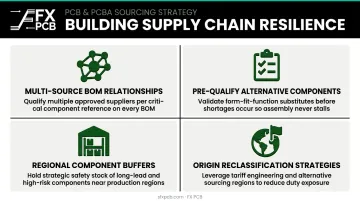
What resilient manufacturers are doing differently:
- Building multi-source relationships for critical BOM line items
- Qualifying alternative components before disruptions force the issue
- Maintaining regional component buffers to absorb sudden availability gaps
- Reclassifying product origin strategies to reduce tariff exposure
SFX PCB's access to over 600,000 locally stocked components through its Shenzhen-based sourcing infrastructure gives customers a practical buffer against these dynamics.
When global availability tightens or tariff classifications shift, an experienced sourcing team that can suggest approved alternatives and move quickly on procurement directly protects production continuity.
Sustainability and Green Electronics Compliance
Global e-waste reached 62 million tonnes in 2022 — up 82% from 2010 — with only 22.3% properly collected and recycled. That gap is driving tighter regulation across every major market, and electronics manufacturers are at the center of it.
EU RoHS restricts ten hazardous substances across all electrical and electronic equipment. REACH and PFAS restrictions are expanding. Extended producer responsibility (EPR) frameworks are active in multiple jurisdictions. The green electronics manufacturing market is projected to grow from $41.83 billion in 2024 to $311 billion by 2035 — a signal that sustainability is a commercial opportunity, not just a compliance cost.
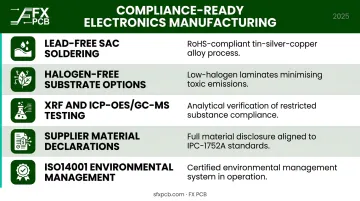
In practice, compliance-ready manufacturing looks like:
- Lead-free soldering (SAC alloys) as standard across all assembly lines
- Halogen-free substrate options for applications requiring stricter material controls
- RoHS and REACH testing using XRF screening combined with ICP-OES/GC-MS analysis
- Supplier-level material declarations as part of procurement qualification
- ISO14001-certified environmental management covering waste, energy, and disposal
SFX PCB holds RoHS, REACH, and ISO14001 certifications, with lead-free soldering standard across production and halogen-free PCB options available as a distinct product line.
Extreme Miniaturization and Advanced Design Complexity
IoT Analytics counted 18.5 billion connected IoT devices in 2024, with 21.1 billion forecast for 2025. Wearable shipments grew 9.1% year-over-year to 611.5 million units. Medical electronics are on a trajectory from $11.1 billion to $15.7 billion by 2029. Each of these categories demands smaller, denser PCBs — and the manufacturing tolerances required to build them reliably.
HDI designs with conductor widths below 50 micrometers, fine-pitch BGAs at 0.1mm spacing, 01005 passives, and multi-layer structures with laser-drilled microvias are becoming standard in high-growth segments. Ultra-HDI — sub-50-micron conductors — represents the next frontier.
The quality stakes rise with every reduction in feature size. A misplaced 0201 component that might be cosmetic on a conventional board can cause functional failure in a medical-grade wearable or automotive sensor array.
Why comprehensive testing is non-negotiable at this scale:
- AOI detects placement errors and solder defects on visible joints
- X-ray inspection verifies solder integrity on BGA and QFN packages where surface inspection can't reach
- Functional circuit testing (FCT) validates actual operating behavior under simulated conditions
- Free DFM analysis catches fine-pitch pad design issues, via-in-pad conflicts, and annular ring violations before production starts — preventing costly rework downstream
SFX PCB supports 01005 package assembly, 0.1mm BGA pitch, laser drilling to 0.10mm, and 1–24 layer fabrication, backed by IPC-A-610 Class 2/3 inspection standards.
Workforce Transformation and the Skills Gap
Deloitte and the Manufacturing Institute project that US manufacturing may need up to 3.8 million additional workers from 2024 to 2033, with 1.9 million potentially going unfilled. Electronics.org reported that 63% of electronics firms said talent shortages constrained growth in 2025 — not technology limitations, not capital access. Talent.
The irony is that automation investment is outpacing workforce readiness. As SMT lines, AI inspection systems, and digital manufacturing platforms replace manual assembly tasks, manufacturers need operators who can program CNC equipment, interpret AI-generated quality reports, and manage connected production systems. That profile is harder to hire than a manual assembly technician, and the training pipeline hasn't caught up.
How manufacturers are responding:
- Investing in apprenticeship and cross-training programs for existing workers
- Partnering with technical colleges to build qualification pipelines
- Redesigning roles around technology augmentation rather than replacement
- Evaluating EMS partners on training maturity, not just labor rate
What's Driving These Trends in Electronics Manufacturing
These five trends share common structural roots.
Technology Is Now Within Reach
AI chipsets, IIoT connectivity hardware, and automation equipment that once required enterprise-scale budgets are now accessible to mid-market manufacturers. Mid-volume production lines can adopt smart manufacturing without the capital commitment that defined the previous decade.
Geopolitical and Regulatory Pressure
US-China trade tensions, the IEEPA tariff actions of early 2025, and expanding EU environmental rules (RoHS, REACH, PFAS) are hitting simultaneously — not sequentially. IPC data shows manufacturers are already responding:
- Renegotiating long-term supplier contracts
- Diversifying sourcing to reduce single-region exposure
- Accelerating automation investment to offset rising input costs
Product Complexity Is Outpacing Legacy Processes
AI-enabled devices, EVs, 5G infrastructure, and medical-grade wearables all require higher layer counts, tighter tolerances, and stricter reliability standards than the product generations they replace. What worked in PCB fabrication three years ago often doesn't meet spec today.
Margin Compression Makes Efficiency Non-Negotiable
Global competition has narrowed margins to the point where operational excellence is a baseline requirement, not a differentiator. Manufacturers are turning to DFM analysis to catch pre-production errors early, smarter procurement to cut material waste, and automation to grow throughput without a proportional rise in labor costs.
How These Trends Are Impacting the Electronics Industry
Operational Impact
Manufacturing workflows are being rebuilt around data rather than manual checkpoints. Real-time AOI reduces rework rates by catching defects before assemblies progress to the next stage. Digital DFM analysis eliminates design-origin errors before a board is run. Automated assembly lines deliver consistent placement accuracy that human operators can't match at volume.
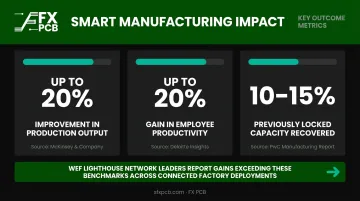
The Deloitte 2025 survey found smart manufacturing investments produced improvements of up to 20% in production output and employee productivity, with 10–15% of previously locked capacity recovered. The WEF Lighthouse data shows even larger gains where AI and closed-loop inspection are fully integrated.
Business Impact
Those efficiency gains are reshaping where capital goes. Investment that previously funded floor space expansion is increasingly directed at technology infrastructure, supplier qualification, and compliance capabilities.
The reshoring signal reinforces this: the Reshoring Initiative reported 244,000 US reshoring and FDI jobs announced in 2024, with computer and electronic products leading at 86,127 jobs, or 35% of the total. Nearshore capacity is growing, but it won't scale without manufacturing partners who can grow alongside it.
Manufacturers who can scale from prototype to high-volume production without switching partners avoid the hidden costs of supplier transitions: requalification time, new tooling, and quality ramp-up curves. In fast-moving segments like consumer electronics and medical devices, that continuity translates directly into time-to-market advantage.
SFX PCB's model addresses this directly — prototype assembly in as little as one week when components are available, scaling to mass production without supplier changes.
Workforce Impact
Smart manufacturing is splitting workforce needs in two. Demand for technically skilled operators, automation engineers, and quality data analysts is growing, while purely manual assembly roles are declining. The "build, buy, or borrow" framework for workforce planning — developing internal talent, hiring externally, or accessing skills through manufacturing partnerships — is a strategic question, not just an HR one.
Future Signals for Electronics Manufacturing Through 2027
Three early signals point to further structural shifts ahead.
6G and Next-Generation RF Requirements
Ericsson positions 6G for commercial readiness by the early 2030s, with Qualcomm research extending into sub-THz bands (100–300 GHz). At those frequencies, PCB laminate selection, signal integrity management, and thermal performance requirements will move well beyond current 5G specifications. PCB manufacturers that begin qualifying low-loss RF laminates now will have a meaningful head start when 6G design requirements solidify.
Physical AI and Humanoid Robotics on the Factory Floor
The IFR reported 542,000 industrial robots installed in 2024, with electronics accounting for 24% of installations — ahead of automotive at 23%. Goldman Sachs projects the humanoid robot market could reach $38 billion by 2035. The near-term implication is practical: humanoid robots extend automation into tasks that current fixed-arm systems can't handle cost-effectively, without displacing the skilled workforce already in place.
Semiconductor Reshoring and Component Availability
The SIA projects the US will triple domestic semiconductor manufacturing capacity from 2022 levels, supported by CHIPS Act investments. As this capacity comes online, it will gradually shift component pricing and lead times for US-based manufacturers. Manufacturers with established global supply relationships and access to diversified local stock will be better positioned to navigate this transition. Those rebuilding procurement networks mid-shift will face both lead time uncertainty and pricing volatility during the adjustment period.
Conclusion
2025 is a year of compounding transformation. AI adoption, supply chain restructuring, sustainability mandates, miniaturization demands, and workforce constraints are all intensifying at the same time — not sequentially. Manufacturers who act now will be better positioned than those waiting for conditions to settle.
For product companies, the most practical path through these pressures is partnering with a manufacturer equipped to handle them. Look for partners that offer:
- Free DFM analysis to catch costly design issues before production
- Multi-stage quality testing (AOI, X-ray, functional testing) built into the process
- Proven supply chain resilience and component sourcing depth
- Seamless scaling from prototype quantities to mass production
The goal is a shorter, more predictable path from concept to market-ready product — with a partner that's already solved the problems you'd otherwise inherit.
Frequently Asked Questions
What are the 5 emerging trends in electronics manufacturing?
The five key trends in 2025 are AI and smart manufacturing integration, supply chain diversification, sustainability and green compliance, extreme miniaturization, and workforce transformation. These span factory floor efficiency, geopolitical sourcing risk, and regulatory pressure — distinct challenges requiring attention at the same time.
How are tariffs impacting electronics manufacturing in 2025?
US tariffs on Chinese imports and related IEEPA actions on Canada and Mexico have raised input costs and disrupted established procurement strategies. The CTA modeled price increases of 31–69% across major consumer electronics categories, pushing manufacturers to diversify sourcing, renegotiate contracts, and explore nearshoring.
What is the biggest challenge facing electronics manufacturers in 2025?
Supply chain volatility — driven by tariff uncertainty, component availability gaps, and geopolitical tension — is the most widely cited concern. The skills gap runs a close second, with 63% of electronics firms reporting that talent shortages constrained growth in 2025.
How is artificial intelligence being used in electronics manufacturing?
AI is deployed primarily in defect detection (AOI and X-ray analysis), predictive maintenance on production equipment, DFM and design validation, and agentic AI systems for supply chain risk monitoring. The most advanced implementations combine these into closed-loop quality systems with measurable gains in defect rates and downtime.
What does supply chain diversification mean for PCB manufacturers?
It means qualifying multiple suppliers for critical BOM line items, maintaining regional component buffers, and reducing dependency on any single geography or vendor. When tariffs shift or a supplier goes down, diversified procurement keeps production running where single-source strategies stall.
How can electronics manufacturers prepare for ongoing industry disruptions?
Invest early in smart manufacturing tools, work with manufacturing partners that offer DFM analysis and supply chain expertise, maintain compliance with global standards (RoHS, REACH, IPC), and build workforce planning around technology-augmented roles.