The challenge? The global market is structured in a way that disadvantages most buyers. A small number of ultra-high-volume manufacturers dominate production capacity, leaving OEMs, startups, and mid-sized companies struggling to find a partner that can match their technical requirements and actually work with them at their current scale.
This guide evaluates the leading flex PCB manufacturers across the full spectrum — from global volume giants to accessible turnkey partners — with enough detail to match your sourcing need to the right manufacturer type.
Key Takeaways
- Flex PCBs enable miniaturization and 3D routing in demanding applications — the manufacturer you choose determines quality, compliance, and scalability.
- Global volume leaders (Nippon Mektron/Mektec, ZDT, Sumitomo) primarily serve large OEMs requiring high-volume contracts.
- Mid-market players like Interflex offer specialized solutions for automotive and display applications.
- SFX PCB is a certified, full-turnkey partner for startups, SMEs, and OEMs — from prototype to production.
- Key selection filters: certifications, DFM support, MOQ flexibility, turnaround speed, and industry-specific experience.
Overview of Flex PCBs in the Electronics Industry
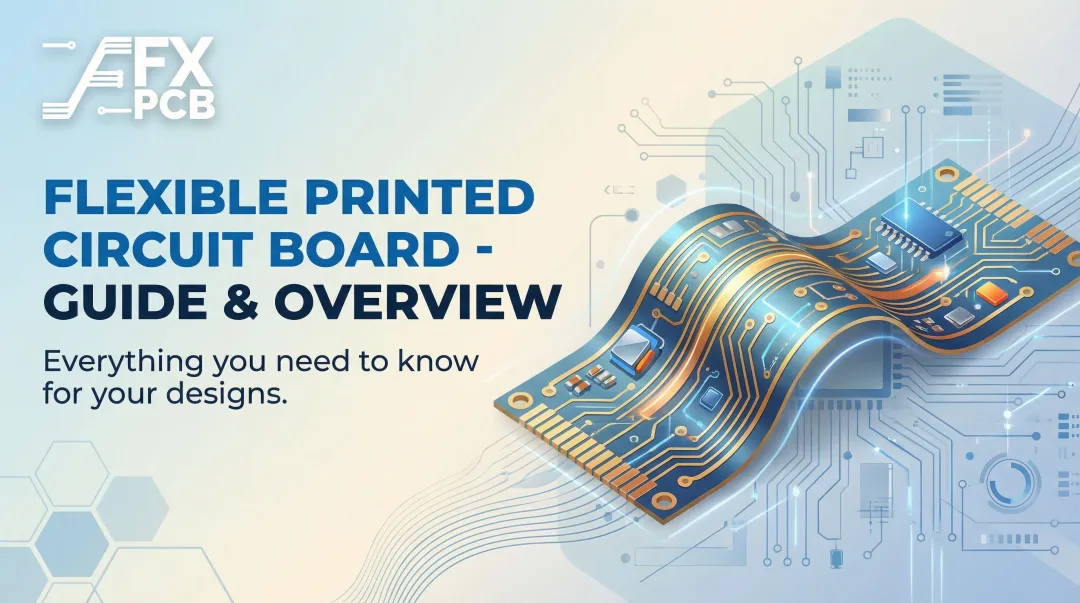
A flex PCB is a printed circuit built on a flexible substrate — typically polyimide or PET — that can bend, fold, and route circuits in three dimensions where rigid boards cannot go.
That capability makes flex PCBs indispensable across several demanding industries:
- Consumer electronics — pack more function into thinner, lighter devices
- Automotive — reduce weight and resist vibration in harsh environments
- Medical devices — enable implants and wearables where rigid boards would fail
The market reflects this demand. According to BCC Research, the global flexible PCB market was valued at $21.5B in 2024 and is projected to reach $41.7B by 2030, reflecting a 12.3% CAGR. Grand View Research puts the 2030 figure higher — near $51B — though analyst estimates vary. Both point to the same demand drivers: EV and battery system adoption, 5G infrastructure buildout, and the rapid growth of connected wearable devices.
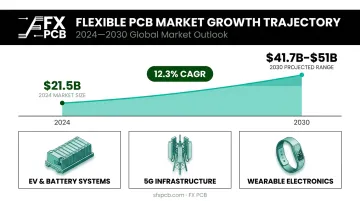
Understanding where the market is headed helps frame what to look for in a manufacturing partner: capacity to scale, experience in your target application, and quality systems built for the industries driving that growth.
Top Flex PCB Manufacturers: Industry Leaders
Manufacturers were assessed across manufacturing capability, certification portfolio, industry focus, production scalability, and real-world accessibility for different buyer profiles. The entries below move roughly from ultra-high-volume Tier-1 suppliers to specialty material innovators, mid-tier precision players, and finally full-service manufacturers accessible to startups and SMEs.
Nippon Mektron (Mektec)
Nippon Mektron — now operating as Mektec Corporation under the NOK Group — was founded in 1970 and is widely regarded as the company that industrialized flexible circuit technology. With factories in Japan, Taiwan (Kaohsiung), and China (Zhuhai and Suzhou), Mektec serves flagship smartphone, automotive, and medical device manufacturers across multiple production tiers.
Its technical differentiation is real: ultra-fine pitch FPC, proprietary stretchable FPC designs, MPI-based high-speed transmission FPC for 5G applications, and sealed water/dust-resistant FPC for harsh environments. Tier-1 OEMs with established supplier relationships and million-unit requirements will find Mektec one of the few manufacturers with the engineering history to match.
The trade-off is accessibility. High-volume focus means smaller buyers will find it difficult to get attention, competitive pricing, or prototype flexibility from this supplier.
| Attribute | Details |
|---|---|
| Key Products | Single/double/multilayer FPC, High-Speed Transmission FPC, Stretchable FPC, Sealed Water/Dust-Resistant FPC |
| Primary Industries | Automotive, Medical Devices, Consumer Electronics, Robotics |
| Best For | High-volume OEMs with Tier-1 supplier relationships and million-unit requirements |
Zhen Ding Technology Group (ZDT)
Headquartered in Taoyuan, Taiwan, with major manufacturing campuses across China and a Thailand facility ramping toward first-phase production in H2 2025, ZDT has been ranked the world's largest PCB manufacturer by revenue for eight consecutive years (2017–2024) according to Prismark data cited in ZDT's own January 2026 investor report.
Its Avary Holding subsidiary concentrates specifically on FPC, HDI, and SLP products for consumer electronics. ZDT's differentiation lies in sheer capacity: ultra-high-volume automated production, substrate-like PCB (SLP) and IC substrate technology, and substantial ongoing capital investment — its 2026 planned capex reportedly exceeded NT$50B.
ZDT is the right call when a global consumer electronics OEM needs millions of densely packed units per month with tight tolerances and no supply risk — but not a realistic option without that scale.
| Attribute | Details |
|---|---|
| Key Products | FPC, SLP, HDI PCB, IC Substrate, Rigid-Flex, Modules |
| Primary Industries | Mobile, Wearable, AR/VR, Networking, Automotive Electronics |
| Best For | Global consumer electronics OEMs requiring extreme-volume, high-density interconnect solutions |
Sumitomo Electric Printed Circuits
Established in 1983 and fully owned by Sumitomo Electric Industries, SEIPC operates production bases in Japan, Vietnam, and the Philippines. What separates Sumitomo from other volume manufacturers is materials science: the company develops its own substrate polymers and has achieved notable firsts in specialty FPC materials.
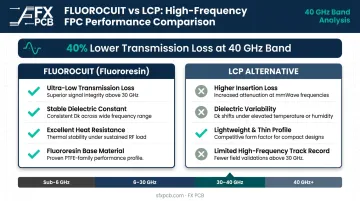
Its FLUOROCUIT fluororesin-based FPC — now in mass production — achieves approximately 40% lower transmission loss in the 40 GHz band compared to liquid crystal polymer alternatives, making it the preferred choice for millimeter-wave and 5G-and-beyond applications. High heat-resistant FPCs (designed for automotive under-hood and powertrain environments), ultra-soft FPCs for robotics, and ultra-fine-pitch designs for HDDs round out a portfolio built on material performance rather than volume competition.
| Attribute | Details |
|---|---|
| Key Products | Ultra-soft FPC, High Heat Resistant FPC, High-Speed/High-Frequency FPC, Double-sided Fine-pitch FPC |
| Primary Industries | Automotive, Medical Devices, Robotics, HDD, Antenna |
| Best For | OEMs with specialty material requirements and strict thermal or high-frequency performance specs |
Interflex Co., Ltd.
Founded in 1994 and headquartered in Ansan, South Korea, with manufacturing in Korea and Tianjin, China, Interflex built its business supplying flex circuits to Korean and global electronics brands across display, smartphone, and automotive applications.
Its distinguishing capabilities include fine-pattern SAP process technology, touch screen panel (TSP) module integration, proprietary low-cost FPCB production, and EMI shielded FPC. OEMs in display-heavy or automotive electronics that need advanced patterning — but can't commit to the enterprise-scale volumes ZDT or Mektec demand — will find Interflex a credible mid-tier option.
| Attribute | Details |
|---|---|
| Key Products | Flex & Rigid-Flex PCB, Touch Screen Panel (TSP) Modules, EMI Shielded FPC, Fine Pattern SAP |
| Primary Industries | Automotive, Display, Wearable, Smartphone, Household Appliances |
| Best For | OEMs in automotive and display applications requiring fine-pattern precision and TSP integration |
SFX PCB
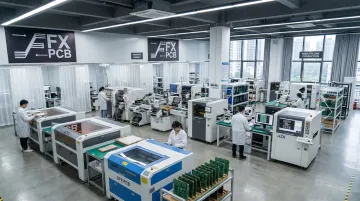
SFX PCB (FX PCB Co.) was built specifically for buyers the volume giants can't serve — startups, SMEs, and growing OEMs that need certified, full-service flex PCB manufacturing without committing to enterprise-scale MOQs. With dedicated PCB and PCBA factories in Shenzhen and a U.S. office in Plano, TX, SFX PCB covers the full journey from 5-piece prototype to mass production under one roof.
What makes SFX PCB structurally different:
- Accepts prototype orders from 5 pieces, scaling to high-volume production without switching suppliers
- Free DFM analysis on every order, with engineering feedback typically within 12 hours of file submission
- 100% electrical testing on every bare board before shipment
- Boards assembled in as little as 24 hours once components are available
- Supports both polyimide and PET flex PCBs; PET variants run approximately 30–40% less than PI equivalents for cost-sensitive applications
- Surface finishes include ENIG, OSP, HASL, immersion silver, immersion tin, ENEPIG, and gold plating
- Up to 8 flex layers in low volume; single and double-layer in mass production
- Parylene nano-vacuum coating achieving IPX-8 protection — suitable for medical and wearable applications
- Full testing suite: AOI, X-ray inspection, ICT, and functional testing (FCT) with custom test fixtures
Certifications: ISO9001, ISO13485, ISO14001, IPC-A-610 Class 2/3, RoHS, REACH, UL
The ISO13485 certification — covering the complete quality management system from raw material procurement through finished PCBA — means SFX PCB can serve regulated medical device supply chains, not just commercial electronics.
| Attribute | Details |
|---|---|
| Key Products | Flex PCB (PI and PET), Rigid-Flex PCB, Turnkey PCBA, Waterproof PCB (Parylene/nano-vacuum coating) |
| Primary Industries | Medical Devices, Automotive, Consumer Electronics, Industrial Automation, Telecommunications |
| Best For | Startups, SMEs, and OEMs needing certified, full-turnkey flex PCB manufacturing from prototype to mass production without switching suppliers |
How to Choose the Right Flex PCB Manufacturer
The most common sourcing mistake is evaluating manufacturers on unit price alone. Unit price ignores the real cost drivers: rework hours from poor DFM support, field failures from inadequate testing, and production delays when a supplier lacks supply chain depth.
The Evaluation Framework
When comparing flex PCB manufacturers, assess them across these dimensions:
- Confirm layer count range, minimum trace/spacing tolerances, substrate options, and drilling capability (laser vs. mechanical)
- Verify certifications relevant to your market: ISO9001 (quality baseline), ISO13485 (medical), IATF 16949 (automotive), IPC-A-610 Class 2/3 (assembly quality), UL, RoHS/REACH
- Ask whether the manufacturer reviews your design before committing to production — or just runs what you send
- Check that the same supplier can handle your prototype today and your volume run next year
- Expect 5–7 days for simple flex prototypes at capable manufacturers; complex multilayer or rigid-flex designs typically need 2–5 weeks
- Prioritize suppliers already certified for your industry — they've built the process controls your product requires
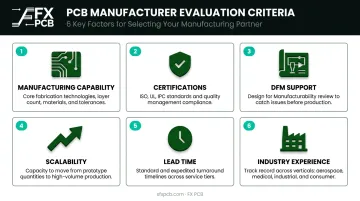
Once you've scored potential suppliers against those criteria, matching them to your buyer profile becomes straightforward.
Matching Manufacturer to Buyer Profile
| Buyer Profile | Best Manufacturer Type |
|---|---|
| Fortune 500 OEM, million-unit volumes | Mektec, ZDT, Sumitomo |
| Automotive/display OEM, advanced patterning | Interflex |
| Startup, SME, or OEM needing prototype flexibility + certification | SFX PCB |
| Medical device company needing ISO13485 PCBA partner | SFX PCB |
The right answer depends on where you are in the product lifecycle and whether the manufacturer you choose today can still serve you at the volume you'll need in two years.
Conclusion
The largest manufacturer isn't automatically the best fit for your project — and neither is the cheapest. The right flex PCB partner is the one whose technical capabilities, certifications, and service model align with your product requirements, volume trajectory, and compliance obligations.
Evaluate ongoing performance indicators — DFM responsiveness, first-pass yield, on-time delivery consistency, and ability to scale — not just the initial quote price. A supplier that saves you $0.10 per board but costs you three weeks of rework has net-negative value — the math doesn't work in your favor.
If those criteria matter to your program, SFX PCB is worth evaluating. For OEMs, startups, and procurement teams that need a certified flex PCB partner — from design review through turnkey assembly — SFX PCB offers direct-manufacturer pricing, free DFM analysis, and certifications covering medical, automotive, and industrial applications (ISO13485, IPC-A-610 Class 2/3, UL). Reach out at info@sfxpcb.com or call (+1) 510-345-5000 to discuss your project.
Frequently Asked Questions
How much does a flex printed circuit board cost?
Flex PCB pricing depends on layer count, substrate material (PET is roughly 30–40% less expensive than polyimide), board complexity, surface finish, and order volume. Prototype quantities carry a significant premium over production volumes — the best approach is to submit your Gerber files for a direct quote, since unit prices vary considerably by specification.
Is Flex the same company as Flextronics?
No. Flex Ltd. (formerly Flextronics International Ltd.) is a Singaporean-American electronics manufacturing services (EMS) company that designs, manufactures, and manages supply chains for branded electronics products — not a flex PCB fabricator. "Flex PCB" refers to a circuit board type, and the manufacturers in this guide are dedicated PCB producers unrelated to Flex Ltd.
What is the difference between a flex PCB and a rigid-flex PCB?
A flex PCB uses flexible polyimide or PET substrate throughout, making it ideal for dynamic bending, cable replacement, and compact routing. A rigid-flex PCB combines rigid FR-4 sections with flexible interconnects in a single construction: it eliminates connectors, improves reliability, and supports compact 3D form factors. This makes it the preferred choice in aerospace, medical, and high-end consumer electronics where both structural integrity and connector reduction are priorities.
What certifications should I look for when choosing a flex PCB manufacturer?
Key certifications by application: ISO 9001 (quality management baseline), ISO 13485 (medical device supply chains), IATF 16949 (automotive), IPC-A-610 Class 2/3 (assembly quality), UL (safety recognition), and RoHS/REACH (global market access). For medical and automotive applications, ISO 13485 and IATF 16949 are regulatory requirements — verify them before shortlisting any supplier.
What is the minimum order quantity (MOQ) for flex PCB manufacturing?
MOQ varies significantly by manufacturer type. Global volume leaders typically require thousands to millions of units per production run. Flexible turnkey partners like SFX PCB accept prototype orders from as few as 5 pieces, making them the practical choice for design validation and early-stage production before committing to high-volume manufacturing.
How long does flex PCB fabrication typically take?
Standard lead times run 5–7 days for simple prototype flex PCBs at well-equipped manufacturers, with complex multilayer or rigid-flex designs requiring 2–5 weeks. Fast-turn services can deliver bare boards in 24–72 hours for straightforward designs; assembled boards can be completed within 24 hours of component availability at specialist manufacturers offering expedited PCBA services.