Introduction
When outsourcing PCB assembly, one of the earliest decisions you face sets the tone for everything that follows: do you hand the entire process to a manufacturer — components included — or do you source parts yourself and pay only for labor and assembly?
These are the two dominant models: turnkey and consignment. The choice affects more than cost — it shapes lead times, internal workload, supply chain exposure, and where accountability sits when something goes wrong.
With EMS accounting for 47% of electronics product production and input costs climbing — the IPC's April 2025 sentiment report put the Material Cost Index at 130 and Labor Cost Index at 128 — picking the wrong model can inflate your total project cost in ways that aren't obvious upfront.
This guide breaks down both models side-by-side across cost, control, risk, and fit, so you can make a call based on your actual situation.
Key Takeaways
- Turnkey: The manufacturer handles everything — sourcing, fabrication, assembly, and testing. You provide design files.
- Consignment: You supply all components; the manufacturer assembles and inspects only.
- Hybrid/partial turnkey: You supply select critical parts; the manufacturer sources the rest. Often the most practical middle ground.
- Turnkey is faster and simpler to manage; consignment gives you direct control over component sourcing.
- "Consignment is cheaper" is a misconception — hidden coordination costs routinely close the price gap.
Turnkey vs Consignment PCB Assembly: Quick Comparison
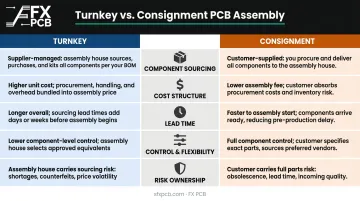
Here's how turnkey and consignment assembly compare across the five dimensions that matter most to your project.
| Dimension | Turnkey | Consignment |
|---|---|---|
| Component Sourcing | Manufacturer procures all parts | Customer sources and ships all components |
| Cost Structure | Higher quoted price; fewer hidden costs | Lower assembly quote; customer absorbs logistics and kitting costs |
| Lead Time | Faster; no dependency on customer's shipping readiness | Depends entirely on customer's ability to kit and deliver complete, correct parts |
| Control & Flexibility | Manufacturer selects approved alternates; client approves major changes | Full control over vendor relationships and approved parts lists |
| Risk Ownership | Manufacturer bears procurement and supply chain risk | Customer bears risk of shortages, incorrect kitting, or transit damage |
What Is Turnkey PCB Assembly?
In a turnkey model, the manufacturer takes full responsibility for the entire production workflow. You provide design files — Gerber files, BOM, pick-and-place files — and the manufacturer handles everything else through to delivery.
What's Included
A capable turnkey partner's scope covers:
- Component procurement and incoming inspection
- Bare board fabrication
- SMT and through-hole assembly (including mixed technology)
- AOI, X-ray inspection, and functional testing (FCT)
- Final packaging and shipping with tracking
Single-point accountability is the core operational benefit. When a component revision is wrong or a reel is missing, one team owns the fix — no finger-pointing between procurement, kitting, and assembly vendors.
Why Turnkey Speeds Up Production
Because procurement, kitting, and assembly are coordinated under one roof, transitions from prototype to production are smoother. There's no waiting for a customer's parts shipment to clear customs before the assembly clock starts. As Ninja Circuits notes, turnaround timing begins only after receipt of the last required part — so in consignment, your schedule is only as fast as your slowest shipment.
SFX PCB's sourcing team draws on over 600,000 local stock components, with boards assembled from 24 hours once all parts are available. Every order includes a free DFM/DFA analysis before fabrication begins, catching footprint mismatches, spacing issues, and annular ring problems before they become rework.
Best Fit for Turnkey
- Startups with no dedicated procurement team
- OEMs scaling to production who need reliable, repeatable execution
- Projects with complex, multi-line BOMs where coordinating dozens of vendors is unmanageable
- Prototype runs where engineering changes mid-build are likely
- Industries where speed to market is non-negotiable (consumer electronics, industrial automation)
For medical device manufacturers, turnkey also centralizes the traceability and quality documentation required under FDA's Quality Management System Regulation (QMSR), which became effective February 2, 2026, and aligns FDA device CGMP requirements with ISO 13485.
What Is Consignment PCB Assembly?
In a consignment model, the customer purchases, sources, and ships all components to the assembly manufacturer. The manufacturer's responsibility starts at the assembly stage — they provide labor, equipment, process expertise, and inspection.
Fully Consigned vs. Hybrid
- Fully consigned: Customer supplies 100% of BOM components. Less common in modern PCB production; most relevant when parts are pre-qualified or contractually customer-furnished.
- Hybrid/partial consignment: Customer supplies select critical or proprietary parts; manufacturer sources the remainder. This model has become the default for most mid-sized businesses.
Where Consignment Makes Sense
Component control and IP protection is the primary driver. Defense and aerospace contractors, for example, often have no choice — DFARS 252.246-7008 requires electronic parts to be sourced first from original manufacturers, authorized aftermarket sources, or authorized suppliers, with full traceability to government acceptance.
Consignment preserves this chain of custody in ways that blanket turnkey procurement cannot.
Beyond compliance, cost savings are the other key driver — though they're context-dependent. If your company already holds purchased inventory, has negotiated volume pricing with distributors, or is drawing from a prior production run, consignment avoids paying a sourcing margin on parts you've already bought.
The Kitting Risk
The kitting risk is where consignment projects most often fail: a single missing or wrong-revision part can halt an entire production run.
Picture shipping a 200-line BOM that arrives 97% complete. That missing 3% — a few passive values or a connector variant — stops the build cold. The manufacturer can't substitute without your approval, so you're coordinating an emergency shipment while your production slot sits idle. A delay of a week is typical.
STHL-PCBA notes that customer-supplied parts can create compatibility issues such as moisture sensitivity level (MSL) management and solderability concerns — issues that don't exist when a manufacturer handles incoming inspection on parts they've sourced and verified.
Best Fit for Consignment
- Companies with established procurement teams and strong distributor relationships
- Projects involving pre-approved or qualified components that cannot be substituted
- Organizations piloting a new assembly partner before committing to full turnkey
- Situations where significant, already-purchased inventory exists
Which Model Should You Choose?
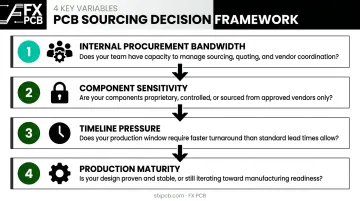
The right model isn't determined by cost alone. Four variables should drive your decision:
- Internal procurement bandwidth — Do you have a dedicated sourcing team?
- Component sensitivity — Are parts contractually customer-furnished or qualification-locked?
- Timeline pressure — How much schedule risk can you absorb?
- Production maturity — Are you prototyping or scaling a proven design?
Decision Summary
| Model | Best For | Main Advantage | Main Risk |
|---|---|---|---|
| Turnkey | Startups, lean teams, complex BOMs, speed-critical launches | Single-point accountability; faster execution | Less direct visibility into component cost |
| Consignment | Defense/aerospace OEMs, pre-qualified parts, existing inventory | Full sourcing control; preserves supplier relationships | Kitting errors gate your entire production schedule |
| Hybrid/Partial Turnkey | Mid-sized businesses, regulated industries with some proprietary parts | Control where it matters; efficiency everywhere else | Requires clear responsibility split across both supply streams |
Two Scenarios That Illustrate the Choice
Company A is a 10-person IoT startup launching their first hardware product. They have no procurement team, a 180-line BOM with components spanning four different suppliers, and a hard launch date. Turnkey is the only model that keeps production moving without adding a sourcing hire before launch.
Company B is a defense electronics OEM delivering assemblies under a government contract. DFARS regulations require them to use customer-furnished components with documented traceability. Consignment isn't a preference here — it's a contractual requirement.
SFX PCB accommodates all three models: full turnkey, consignment, and partial turnkey. For hybrid orders, the sourcing team coordinates directly with you on the split — suggesting alternatives for standard passives while you retain control over lifecycle-sensitive or proprietary parts. All proposed substitutions require your explicit approval before implementation.
Cost Breakdown: What You're Really Paying For
Here's a misconception that costs procurement teams real money: assuming consignment is always the cheaper option. The math is more complicated than the quote sheet suggests.
The Turnkey Cost Structure
A turnkey quote is higher on the surface because it includes component cost plus the manufacturer's sourcing margin. That quoted price also bundles significant value that reduces total project cost:
- No internal procurement labor
- No excess inventory carrying costs
- No delays from kitting errors
- Manufacturer's bulk buying power often offsets or eliminates the sourcing margin on standard components
Circuits Assembly reports that turnkey quoting commonly includes 10–25% markups on bare boards — a real cost to consider. But comparing a turnkey quote to a consignment assembly-only quote is an apples-to-oranges mistake. The assembly-only number doesn't reflect total project cost.
The Consignment Cost Structure
The assembly-only quote looks lower, but that number shifts once you account for everything the customer takes on directly:
- Inbound freight and customs (especially if sourcing internationally)
- Component over-ordering to cover attrition and inevitable shorts
- Internal labor for kitting, labeling, and coordination
- The cost of production delays if anything is missing or wrong
For companies without established procurement infrastructure, these hidden costs frequently exceed what the manufacturer's sourcing margin would have cost in the first place.
The Total Cost of Ownership Lens
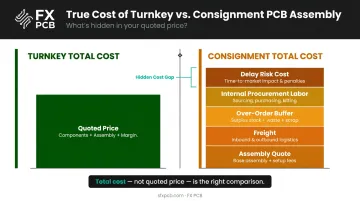
The right comparison isn't turnkey price vs. consignment assembly price. It's:
Turnkey total cost = Quoted price (components + assembly + margin)
Consignment total cost = Assembly quote + freight + over-order buffer + internal procurement labor + delay risk cost
For teams with mature sourcing operations and existing component inventory, consignment's total cost can be genuinely lower. For startups, SMEs, or teams without a dedicated procurement function, turnkey's bulk buying power and coordination efficiency deliver better total cost of ownership — regardless of what the line item shows.
Frequently Asked Questions
What is the difference between turnkey and consigned PCB assembly?
In turnkey, the manufacturer sources all components and manages the full production process — procurement through delivery. In consignment, the customer supplies the components and the manufacturer performs assembly and inspection only.
What files do I need to provide for turnkey PCB assembly?
For a standard turnkey order, you'll need to provide your Gerber files, a complete BOM, and a pick-and-place (centroid) file. SFX PCB's team reviews these for DFM issues before production begins — at no additional cost.
Is turnkey PCB assembly more expensive than consignment?
The quoted price is higher because it includes component costs. But when you account for consignment's hidden costs — logistics, internal procurement labor, kitting coordination, and delay risk — turnkey often delivers lower total project cost.
How does lead time differ between turnkey and consignment assembly?
Turnkey is generally faster. SFX PCB can begin assembly within 24 hours once all parts are confirmed in stock. Consignment lead times depend on how quickly the customer can source, kit, and ship components — delays at any step push back the entire schedule.
Which PCB assembly model is best for startups?
Turnkey is generally best for startups. Most lack procurement infrastructure and can't absorb the coordination overhead that consignment requires. Faster execution and clear accountability make turnkey the lower-risk choice for first hardware products.
Can I supply some components and let the manufacturer source the rest?
Yes — this is called partial turnkey or hybrid assembly. SFX PCB offers this model: you supply select critical or proprietary components, and their sourcing team manages the remainder of your BOM. All proposed component substitutions require your approval before implementation.