IPC — now operating as the Global Electronics Association — publishes over 300 standards that govern every stage of the PCB lifecycle, from design through fabrication, assembly, and repair. These standards are used by companies in 90+ countries and developed through collaboration among more than 3,000 volunteer industry professionals.
This guide covers what IPC standards actually mean, which ones govern fabrication and assembly decisions, how the three quality classes differ, and what to look for when qualifying a certified manufacturer.
Key Takeaways
- IPC (now Global Electronics Association) sets globally recognized standards for PCB design, fabrication, and assembly quality across 300+ active documents
- Key standards: IPC-A-600 (bare board inspection), IPC-A-610 (assembly quality), IPC-6012/6013 (rigid/flex qualification), IPC-2221 (design rules) — each targeting a distinct phase of production
- Classes 1, 2, and 3 define escalating quality requirements; Class 3 applies to medical, aerospace, and defense
- IPC standards are voluntary but effectively required to qualify with most major OEMs
- ISO 9001, ISO 13485, RoHS, and UL certifications work alongside IPC to validate a manufacturer's complete quality system
What Is IPC and Why Does It Matter in PCB Production?
IPC was originally founded as the Institute for Printed Circuits. Today it operates as the Global Electronics Association (legal name: IPC International Inc, DBA Global Electronics Association) — a global trade association that develops voluntary consensus standards through industry volunteer committees. Its catalog covers the entire PCB lifecycle from design through assembly, rework, and material declarations.
That scope is exactly why IPC compliance shows up in supplier contracts across virtually every demanding industry.
Why IPC Compliance Functions as a Market Requirement
IPC standards aren't legally mandated, but that distinction barely matters in practice. Major OEMs and government contractors routinely build IPC compliance into supplier contracts.
Lockheed Martin's supplier quality requirements (QM003, 2023) specify that electronic PCB assemblies must meet IPC-A-610 Class 3 unless otherwise agreed, and that contract electronic manufacturing suppliers require special-process approval through an IPC J-STD-001 audit. RTX/Raytheon similarly references IPC-A-610 in supplier documentation for aerospace and defense assemblies.
Beyond supplier qualification, IPC standards deliver three practical benefits:
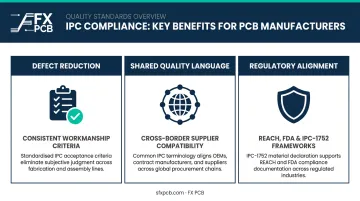
- Reduces defects through documented workmanship criteria that inspectors and operators apply consistently
- Creates a shared quality language that travels across global supply chains, enabling cross-supplier compatibility
- Supports regulatory alignment: IPC-1752 facilitates REACH material declaration data exchange, while IPC-A-610 criteria align with FDA quality system frameworks for medical device manufacturing
IPC certification is not the same as legal compliance with RoHS, REACH, or FDA regulations. Each operates at a different layer of the quality system.
Key IPC Standards Every PCB Buyer Should Know
While 300+ standards exist, a handful govern the majority of fabrication and assembly decisions. Here's a practical reference for the ones that matter most.
IPC-A-600: Acceptability of Printed Boards
Current revision: M (May 2025)
IPC-A-600 sets visual acceptability criteria for bare, unfabricated printed circuit boards. It covers defects including pits, scratches, voids, conductor damage, and laminate issues — organized into target, acceptable, and nonconforming conditions that can be observed externally or internally.
This is the standard inspectors apply during bare board evaluation before assembly begins. If a board doesn't pass IPC-A-600, it never reaches the assembly stage.
IPC-A-610: Acceptability of Electronic Assemblies
Current revision: J (March 2024)
IPC-A-610J governs the quality of completed PCB assemblies — solder joint quality, component placement, cleanliness, and coating. The key distinction from IPC-A-600: A-600 applies to bare boards, while A-610 applies to assembled boards. Both are necessary to assess full product quality across the manufacturing chain.
IPC-A-610 is structured by quality class, which means the acceptability criteria tighten significantly from Class 1 through Class 3.
IPC-6012 and IPC-6013: Performance Qualification Standards
IPC-6012 Revision F (October 2023) covers rigid printed boards — single-sided, double-sided, multilayer, and metal-core — specifying electrical, mechanical, and thermal requirements boards must meet to qualify for demanding applications.
IPC-6013 Revision E (September 2021) addresses the same qualification purpose for flexible and rigid-flex printed circuit boards, covering the unique mechanical and material requirements of flex substrates. Engineers specifying flex or rigid-flex PCBs should reference IPC-6013 rather than IPC-6012 — the substrate characteristics, bend requirements, and performance criteria differ significantly.
IPC-2221: Generic Standard on Printed Board Design
Current revision: C (December 2023)
IPC-2221 is the foundational design standard, providing rules for conductor spacing, material selection, via sizing, and layout practices that affect both manufacturability and end-use performance.
Applying these guidelines early prevents costly downstream fabrication problems. Trace spacing violations, insufficient annular rings, and via aspect ratio issues are far cheaper to fix in a Gerber file than after first article production.
IPC-7711/7721 and IPC-7527
IPC-7711/7721 Revision D (January 2024) governs rework, modification, and repair of PCB assemblies. It specifies tools, materials, and procedures — including coating removal — for programs where boards require field maintenance or modification, such as medical devices and aerospace systems.
IPC-7527 defines process requirements for soldering operations: temperature profiles, flux usage, and process controls. Where IPC-A-610 evaluates the acceptability of a finished solder joint, IPC-7527 governs how that joint gets made. Complete process and output control requires both.
IPC Classes 1, 2, and 3: Choosing the Right Level
IPC-A-600 and IPC-A-610 both organize requirements into three classes based on end-use environment. The class you specify determines inspection rigor, defect tolerance, and documentation requirements.
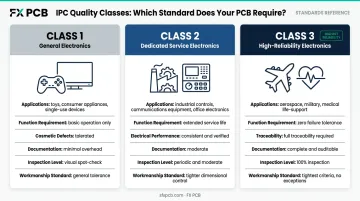
| Class | Product Type | Key Characteristics |
|---|---|---|
| Class 1 | General Electronics | Basic function required; cosmetic imperfections acceptable; lower testing overhead |
| Class 2 | Dedicated Service Electronics | Extended service life; consistent electrical performance; more rigorous inspection than Class 1 |
| Class 3 | High-Reliability Electronics | Zero tolerance for failure; full traceability; 100% inspection; tightest workmanship criteria |
Class 1 — General Electronics
Class 1 applies to limited-life products where the primary requirement is basic function. Toys, disposable electronics, and low-cost consumer devices typically fall here. Minor cosmetic defects that don't affect electrical performance are acceptable, and documentation and testing overhead is lower.
Class 2 — Dedicated Service Electronics
Class 2 targets products requiring reliable performance over an extended service life in non-extreme environments. Industrial controls, commercial communications equipment, office electronics, and non-safety automotive components are common examples. Some cosmetic variation is acceptable, but consistent electrical performance and more rigorous inspection than Class 1 are required.
Class 3 — High-Reliability Electronics
Class 3 covers products where failure is not acceptable — medical implants, aerospace flight controls, military systems, and life-safety equipment. The requirements include the tightest workmanship criteria, full traceability, 100% inspection, and process controls that minimize any risk of solder voids, misalignment, or contamination.
Applying a lower class to a Class 3 application has real consequences. The FDA's device recall database includes cases where inadequate process controls on PCBAs — including insufficient curing of protective coatings — led to leakage, electrical malfunction, and product recalls. Defense and aerospace OEMs enforce detailed supplier quality requirements for the same reason: assembly escapes in high-reliability hardware aren't recoverable failures.
How to Choose the Right Class
Start with the failure scenario: if a malfunction could injure someone, cause mission failure, or trigger a recall, Class 3 is the floor. Products that need sustained, reliable performance in normal commercial conditions belong in Class 2. Class 1 is only appropriate when the product is genuinely cost-sensitive, short-lived, and failure has no safety or reputational consequence.
Misclassifying downward is a common mistake. Inspection savings rarely offset the cost of field failures or a recall.
Choosing the right class is only half the equation — the manufacturer has to be certified to deliver it. SFX PCB holds IPC-A-610 Class 2 and Class 3 certification, meaning assembly processes and inspection criteria are validated for both commercial-grade and high-reliability applications. Customers can scale from industrial automation projects to medical devices or aerospace assemblies without switching suppliers as specifications tighten.
Complementary Certifications That Work Alongside IPC
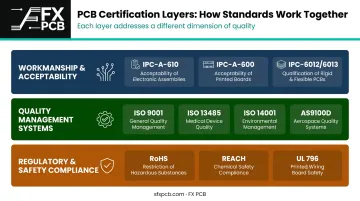
IPC standards address workmanship and acceptability — they don't cover a manufacturer's broader quality management system, environmental practices, or regulatory compliance obligations. Several certifications address each of these areas.
Quality Management System Certifications
- ISO 9001:2015 — The foundational QMS framework for organizations of all sizes. It doesn't define PCB workmanship criteria but ensures that the processes producing those boards are systematically managed and continuously improved. Most serious OEMs require it alongside IPC credentials.
- ISO 13485:2016 — The medical device-specific QMS standard. ISO 13485 extends the ISO 9001 framework with requirements for risk management, process control, and traceability specifically relevant to medical device supply chains. A manufacturer serving medical OEMs needs ISO 13485, not just ISO 9001.
- ISO 14001:2015 — Environmental management system certification. Multinational OEMs increasingly mandate it as part of supply chain ESG vetting — without it, qualifying for global enterprise programs becomes significantly harder.
RoHS and REACH Compliance
RoHS (EU Directive 2011/65/EU) restricts hazardous substances — including lead, mercury, cadmium, hexavalent chromium, and several flame retardants — in electrical and electronic equipment. REACH governs chemical safety more broadly across EU markets. Both are non-negotiable for products targeting European or most global markets.
Meeting these legal requirements requires documented substance data from every tier of the supply chain. IPC-1752 supports that process by providing a standardized format for material declaration exchange — though it doesn't replace the underlying legal obligation to restrict prohibited substances.
UL Certification
UL 796 addresses electrical safety requirements — primarily fire and shock risk — for printed wiring boards used as components in devices or appliances. It's frequently required for products sold in the US market. UL focuses on component safety, not manufacturing workmanship quality, so it complements rather than duplicates IPC coverage.
SFX PCB holds ISO 9001, ISO 14001, ISO 13485, IPC-A-610 Class 2/3, RoHS, REACH, and UL certifications across its PCB fabrication and PCBA facilities in Shenzhen. For buyers running multi-standard supplier qualifications, that consolidation removes the need to split orders across vendors to meet different certification requirements.
How to Evaluate and Verify a Certified PCB Manufacturer
Certifications to Request Before Engaging
Before approving a PCB manufacturer, request current documentation for:
- IPC-A-610 class certification — confirm Class 2 or 3 if your application requires it
- ISO 9001 — baseline for quality management
- ISO 13485 — required for medical device supply chains
- AS9100D — required for aerospace and defense (built on ISO 9001 with sector-specific additions)
- RoHS and REACH compliance declarations
- UL listing — if selling into the US market
When reviewing these documents, check that each certificate specifies scope. Not all certifications cover every process or facility: a manufacturer's ISO 9001 certificate might cover fabrication but not assembly, or vice versa.
Collecting the right documents is only the first step. Once you have them, verify that each one actually applies to the work you're contracting.
Practical Verification Steps
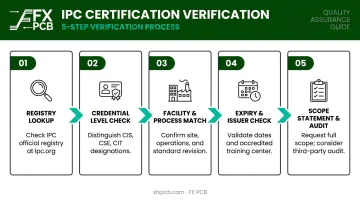
- Look up individual IPC certificates through IPC's official registry at ipc.org — it lets you look up certificates for individually certified professionals
- Confirm the certification level: IPC distinguishes between CIS (Certified IPC Specialist), CSE (Certified Standards Expert), and CIT (Certified IPC Trainer) credentials
- Match the certificate to the actual facility and process — ask which site, which operations, and which revision of the standard the certification covers
- Check expiry dates and confirm the issuing body is an accredited IPC training center
- For high-stakes projects, request the full scope statement and consider an on-site or third-party audit
Frequently Asked Questions
What is IPC in PCB manufacturing?
IPC — now the Global Electronics Association — is a global trade association that publishes over 300 standards governing the design, fabrication, assembly, testing, and repair of printed circuit boards. Its standards are used by manufacturers in 90+ countries and developed through industry volunteer committees.
Is IPC certification worth it?
For manufacturers, IPC certification reduces defects and rework costs while qualifying them for OEM and government contracts. For buyers, it provides a consistent quality language across global supply chains. In practice, certification is mandatory for anyone supplying regulated or commercial markets.
What are the main standards for PCB production — is there an ISO standard?
PCB production is governed by IPC standards (IPC-A-600, IPC-6012, IPC-A-610, and others) for workmanship and acceptability, while ISO 9001 provides the overarching quality management system framework. Most OEMs require both, as each standard operates at a different layer of the quality system.
What is the difference between IPC-A-600 and IPC-A-610?
IPC-A-600 sets visual acceptability criteria for bare, unfabricated printed circuit boards. IPC-A-610 sets acceptability criteria for completed electronic assemblies, including solder joints and component placement. Both are needed to assess full product quality.
What is the difference between IPC-6012 and IPC-6013?
IPC-6012 specifies qualification and performance requirements for rigid printed boards. IPC-6013 covers the same qualification scope for flexible and rigid-flex printed circuit boards. The correct standard depends on the board type being manufactured.
What is the IPC-7527 standard?
IPC-7527 defines process requirements for soldering operations — temperature profiles, flux usage, and process controls. It's distinct from IPC-A-610, which evaluates the acceptability of the finished solder joint rather than the process used to create it.